
Glendora Epoxy Flooring has been specifying and installing epoxy flooring in Walnut for more than 20 years, and the work here tends to run toward the higher end of what a garage slab can carry. That is not salesmanship, it is a response to the concrete. When the substrate is sound and consistent, the sensible thing to do is build a better floor on it rather than shave the specification down.
Every quote we write names the product, the mil build and the cure schedule in plain language. A homeowner comparing two proposals should be able to see where they differ, and a bid that lists only a square-foot price hides exactly the details that decide how long the floor lasts. We would rather be judged on what is written down.
That approach also means we say no to things. If a slab is not a candidate for a full flake broadcast or a metallic build, we say so and quote what it will actually support. A high-specification system installed over the wrong preparation is a more expensive failure than a modest one done properly.
Specifying Up Rather Than Pricing Down
A Deep Market Rather Than a Wide One
Walnut is close to a pure residential garage market. One-unit detached homes make up 94.7% of the housing stock, 8,737 of 9,230 units, with attached single-family at 2.1% and just nine mobile homes in the entire city. Homeownership runs 83.8%, which means almost every household that calls owns both the house and the bay the floor is going into.
That has a practical effect on how we work. There is no chain of approvals to clear and no absentee owner to satisfy, so the conversation is directly with the person who will park on the floor and live with it. Decisions get made once, by the person who cares most about the outcome.
What a Written System Spec Actually Contains
A system spec from us names the primer, the body coat and the topcoat by product, states the total mil build, and gives the recoat window and the cure schedule with return-to-service times for foot traffic and for vehicles. It also names the surface profile we are opening the slab to. That is five or six lines, and every one of them is checkable.
We write it that way because it is the only honest basis for comparison. Two bids that both say epoxy garage floor can differ by a factor of three in film thickness and by an entire product family in the topcoat. Putting the numbers on paper is how a homeowner tells a thin roll-on job from a built system.
Epoxy Base, Polyaspartic Topcoat, and When Each Belongs
A 100% solids epoxy body coat gives thickness and build, and it is what carries a heavy vinyl flake broadcast or a quartz broadcast. A polyaspartic or clear urethane topcoat over it adds abrasion resistance and a faster return to service, and it holds gloss better under a garage door that faces the afternoon sun. The two are partners rather than competitors.
Which combination we recommend depends on how the space is used. A bay that sees a daily commuter, a workbench and a set of jack stands gets a different build from one that stores two cars and little else. We ask about the use before we pick the products, because that is the order the decision actually runs in.
Looking for epoxy flooring closer to Claremont? See Epoxy Flooring Services in Claremont.
What a Modern Slab Lets You Build
A Substrate That Repeats Across the Tracts
Nearly half of Walnut went up in a single decade: the 1980s account for 47.9% of the housing stock, 4,419 units, while 38.4% predates 1980. That concentration means the slabs we meet here are largely modern pours placed with a vapor retarder underneath them, and moisture-driven bond failure is the exception here rather than the rule.
We still check rather than assume, because a bad reading on one address is worth more than a good average across a city. But the check is a verification step here, not the argument the whole job turns on, and that frees the budget to go into the coating system instead of into remediation.
Joints, Saw Cuts and Movement
A modern garage pour usually arrives with control joints cut into it, and those joints exist because the concrete needs somewhere to move. Skimming a coating flat across them looks tidy on day one and telegraphs a crack through the finish within a season. We treat each joint on its merits, honoring it through the coating or filling it with a polyurea joint filler where the movement has clearly stopped.
Cracks that have opened since the pour get chased out and filled rather than covered, and spalled edges near the door get rebuilt before anything else goes down. None of this is glamorous, and all of it is visible in year three.
Profile Opened Mechanically, Never Etched
The slab is opened with a diamond grinder running a planned grit sequence, moving to PCD tooling where an old sealer or a previous coating has to come off first. We grind to a named ICRI concrete surface profile appropriate to the system, and that number goes on the spec so there is a standard to measure the work against.
Acid etching is not something we do. It gives an inconsistent bite across a floor, leaves residue behind in the pores and produces no profile anyone can name or verify. Grinding dust is pulled at the tool with HEPA extraction, which keeps the mess inside the bay rather than spreading it over the driveway and whatever is parked on it.
High-Build Systems on a Sloped Pad
Sloped Driveways and Getting the Equipment There
Walnut’s tracts follow the hills, and the driveways follow the tracts. Before a date is promised we survey the approach, because a planetary grinder, a dust extraction rig and a loaded truck all have to reach the bay and stay put safely once they are there. A steep or narrow approach can change the equipment package or the crew size.
Doing that survey first is what prevents the worst version of this job, which is a crew arriving with gear that cannot be brought up to the garage. It costs us an appointment and saves everyone a wasted morning.
Pitch Toward the Door, and How a High-Build Product Behaves
A garage slab is built to shed water toward the door, and on a hillside pad that pitch is often steeper than the minimum. A high-build or self-leveling product placed on a slope wants to keep moving, which changes how the material is gauged out and how quickly it has to be worked.
So the crew adjusts rather than fighting it. Material is gauge-raked to a controlled thickness and backrolled promptly rather than being flooded and left to find its own level, and the working sequence runs with the slope instead of against it. This is where the difference between an experienced crew and a fast one shows up.
Slip Resistance Where the Slope Is Real
The steeper the pitch, the more the finished surface texture matters. A heavy flake broadcast with a clear urethane topcoat already carries some texture, and where a floor needs more we can add an aluminum oxide broadcast into the topcoat to raise slip resistance without turning the surface into something that cannot be cleaned.
We would rather have that conversation before installation than after the first wet weekend. Gloss and grip pull in opposite directions, and choosing between them is the homeowner’s call once the tradeoff is explained.
Finishes Worth the Slab They Sit On
Full Flake, Quartz and Metallic Effects
A full vinyl flake broadcast, seated into a 100% solids epoxy and locked under a clear urethane topcoat, is the workhorse of the high-specification garage and hides slab variation better than any other finish. A quartz broadcast trades some of that camouflage for a heavier, more granular surface. A metallic pigment build goes the other direction entirely, producing depth and movement rather than uniformity.
The metallic systems in particular reward a good substrate, because there is nowhere for a defect to hide in a floor designed to be looked into. That is another reason the specification conversation here starts from what the slab can support rather than from a catalog.
Sampling on Your Own Concrete
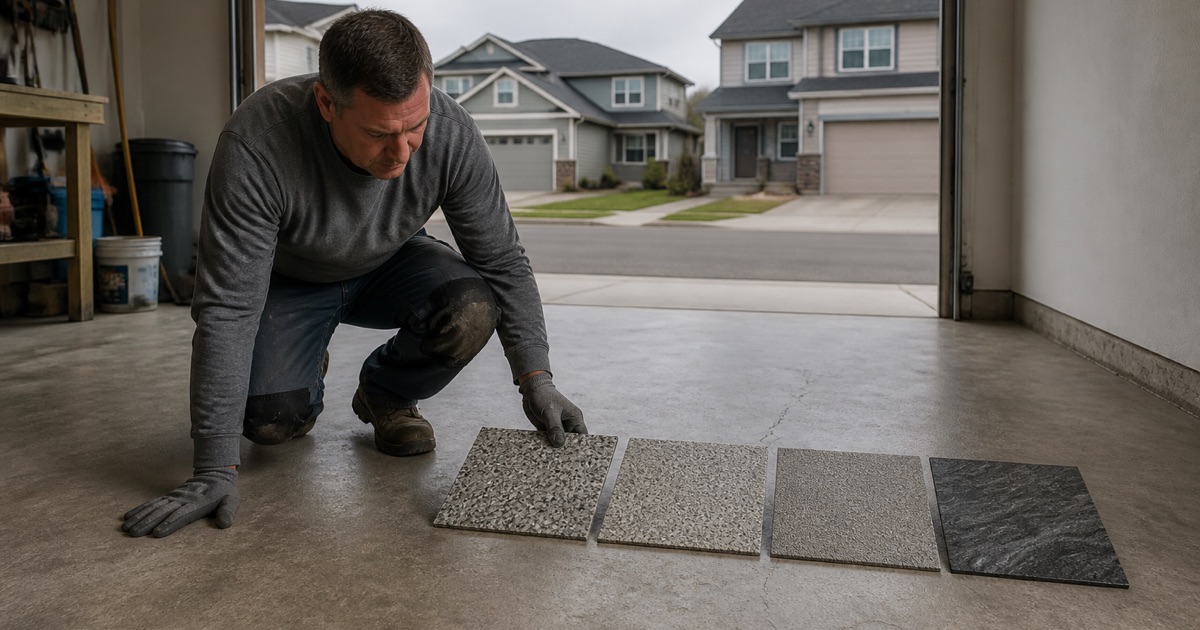
Color decisions get made on your slab, in your garage, under your lighting. We lay a sample where the floor is going rather than handing over a chip from a binder, because a flake blend over gray concrete under a single fixture is a different object from the same blend under showroom light.
It adds a visit to the process and it removes the one complaint nobody can fix afterward. Once the coating is bonded, changing the color means grinding the floor off and starting over.
Coating Category, Legality and Scheduling
Walnut falls under the South Coast Air Quality Management District, whose Rule 1113 caps floor coatings at 50 g/L VOC and industrial maintenance coatings at 100 g/L, with subsection (c)(6) prohibiting industrial maintenance coatings for residential use. A home garage here gets a floor coating category product, and we name the category we are quoting. Where a job touches the city’s own process, Building and Safety sits in the Community Development Department at 21201 La Puente Road.
Scheduling then runs against slab temperature rather than the calendar. Pot life on the same product moves from roughly 60 minutes at 55 degrees to about 20 minutes at 95 degrees, so a summer job in an uninsulated garage gets smaller batches and an earlier start. The same crew stays on the floor from the first grinding pass through the final topcoat, so there is no handoff to a subcontractor in the middle of a system that depends on its own recoat windows.
- 20+ Years Experience
- Every Slab Moisture Tested
- Written System Spec