
Glendora Epoxy Flooring installs epoxy flooring in Vincent, and after more than 20 years on San Gabriel Valley concrete we treat this community’s slabs as their own category of work. Almost every garage here sits on original mid-century concrete rather than a modern pour. That one fact drives the preparation, the schedule and the number at the bottom of the quote.
So we do not price a floor here from a phone call. We measure the bay, test the slab and look at what seventy years of use has left behind before a figure is written down. A post-war two-car garage is narrower than a modern one, and the finished coated area is regularly smaller than the owner expected.
Every quote carries a written system spec naming the product, the mil build and the cure schedule, so two proposals can be set side by side and actually compared. One crew handles the work from the first pass of prep through the clear urethane topcoat. Nothing gets handed off to a subcontractor between the rough work and the finish.
An address that reads Covina or Azusa
Which side of Arrow Highway the property sits on
Vincent is a census-designated place, and the mail does not carry its name. Addresses south of Arrow Highway are written Covina with the 91722 zip code, and addresses north of it are written Azusa with 91702. Residents here generally describe where they live by the address on their bills rather than by the census label.
We raise this because it decides how a job gets booked and how the paperwork reads. Someone who tells us they are in Covina may well be inside the Vincent CDP, and the reverse happens just as often. Neither answer settles who inspects the work, so we never treat the envelope as evidence.
Confirming the jurisdiction from the parcel
The CDP covers about 1.473 square miles, small enough that a property a block away can fall under an entirely different building department. Getting that wrong costs a permit cycle rather than a phone call. We verify jurisdiction from the parcel rather than the mailing address before committing to a schedule, and we would sooner spend ten minutes on it at the estimate than discover it later.
In practice, coating an existing residential slab is rarely what pulls a permit anyway. What pulls one is the work owners tend to bundle alongside it: a new circuit, added lighting, a floor drain or a change to the mechanical. We flag those at the walkthrough so the timeline reflects an inspection if one applies.
The county counter instead of a city hall
Vincent is unincorporated, so there is no municipal building department to walk into. Building and Safety for this community runs through the Los Angeles County Department of Public Works at its San Gabriel Valley District Office, 125 South Baldwin Avenue in Arcadia, reachable at (626) 574-0941. That is a different counter, a different fee schedule and a different inspection route from any incorporated city nearby.
One authority does not shift with the jurisdiction. The South Coast Air Quality Management District covers the whole area, and Rule 1113 caps floor coatings at 50 g/L VOC and industrial maintenance coatings at 100 g/L, with subsection (c)(6) barring an industrial maintenance coating from residential use. We pick the coating category against those limits first, so the product going down is legal for the building it is going into.
Looking for epoxy flooring closer to Duarte? See Epoxy Flooring Services in Duarte.
Shot blasting a 1950s slab instead of grinding it
What decades of oil do to a profile
Around 71.6% of Vincent’s 3,927 housing units were built in the 1950s, and 94.2% predate 1980. A garage slab in service that long has usually absorbed oil, brake fluid and whatever else drained out of the cars parked on it. Contamination at that depth does not wash off; it comes away with the top layer of concrete or it does not come away at all.
A diamond grinder can polish contamination flat instead of cutting through it, producing a surface that looks clean and bonds badly. That is the failure mode we are guarding against on this housing stock. Nothing goes down until the profile is genuinely open, and we confirm that across the whole bay rather than in one convenient corner.
Choosing between the shot blaster and the grinder
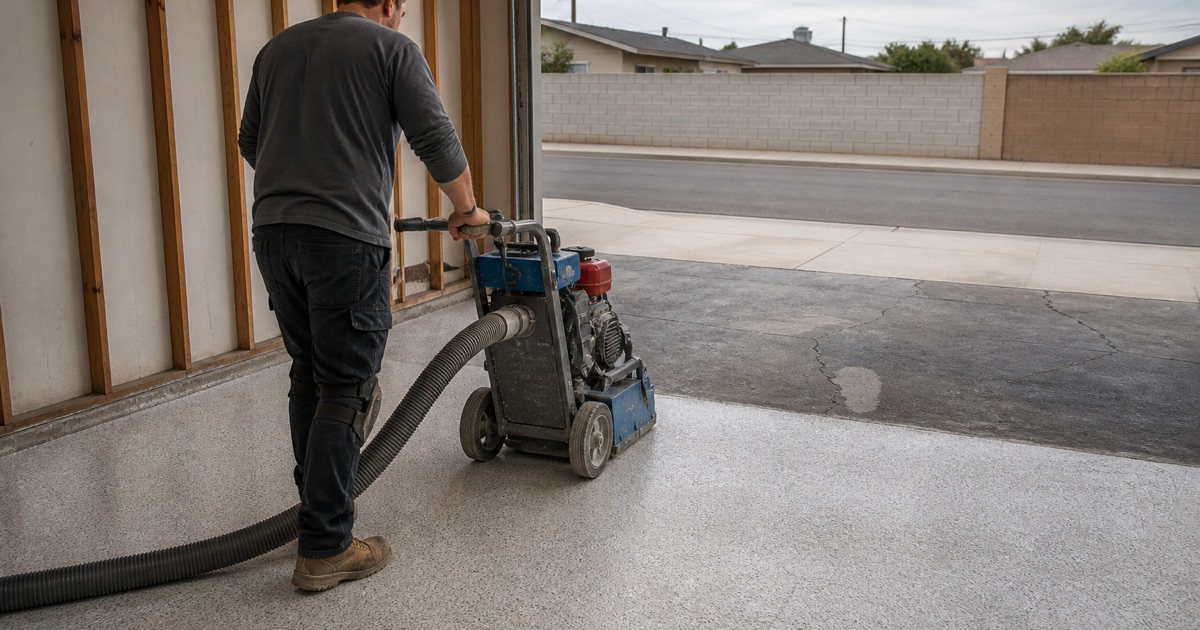
Where saturation and old sealer run heavy, a shot blaster removes more material per pass and leaves a deeper, more uniform texture than diamond tooling does. We select the machine and the grit sequence to reach a named ICRI concrete surface profile, and we never substitute acid etching for mechanical prep. Etching softens a surface without opening it.
Where the concrete is sound and the contamination is light, PCD tooling followed by a diamond segment grit sequence is the better call. The point is that the tool follows the slab, not the invoice. Deciding the method before seeing the floor is how a job ends up either under-prepped or needlessly aggressive, so we make that call on site.
Moisture on concrete poured before vapor retarders
Slabs of this vintage generally went in before under-slab vapor retarder practice became standard, which makes vapor drive from the soil a live question rather than a formality. We measure it with in-situ relative humidity probes to the ASTM F2170 method and write the reading on the file before any material is ordered. Moisture failure is the exclusion almost every coating warranty carries.
A high number does not end the conversation. It changes the specification, usually toward a moisture vapor barrier primer under the build instead of a standard primer coat. What it must never do is stay unknown until the coating starts lifting a year later, when it has become the owner’s problem rather than ours.
Cracks, patches and the history under the coating
Chasing cracks rather than covering them
Seventy years of settlement leaves cracking in a slab, and a coating rolled straight over a live crack telegraphs through within a season. We chase each one open, clean it out and fill it with polyurea joint filler so the repair carries load rather than sitting in the gap. Control joints and saw cuts get the same treatment where they need it.
Deciding which movement to honor and which to fill is a judgment made on the floor. A joint that is still working should be respected in the finished surface, not buried under it. One that has stopped can be filled and disappear beneath a vinyl flake broadcast, so we walk the bay and mark them before the machines come out.
Old patches and what sits underneath
Most slabs here have been repaired before, often more than once, and earlier patch work rarely matches the surrounding concrete in density or absorbency. Ground or blasted, those areas accept coating differently and can read as a shadow through a light-colored finish. Spall repair around the door track and along the apron is common at this age as well.
We map the patched areas during prep and treat each as its own substrate, adjusting the primer coat where absorbency demands it. Where a patch is already failing, it comes out rather than gets coated over. That decision costs an hour and saves a callback, which is a trade we take every time.
Why a fixed price sight-unseen is a trap
On this housing stock, preparation is a larger share of the total job than the coating itself, and its extent cannot be guessed from a photograph. A quote given over the phone either carries enough padding to be uncompetitive or enough optimism to be revised halfway through. Neither position serves the owner.
So we walk the slab, measure the bay, test for moisture and price what is actually in front of us. HEPA dust extraction pulls debris at the tool throughout that prep, which matters more here than usual because the work is heavy and the houses sit close together. The dust stays inside the garage instead of drifting across the yard and the cars.
A strong garage market on small lots
Detached houses on nearly every parcel
The unincorporated label understates what is here. Detached single-family houses account for 93.6% of Vincent’s housing units, 3,675 of 3,927, with no mobile homes recorded at all and only 2.1% attached. Owner occupancy runs at 77.9% and median household income is $100,443, which is a stronger garage market than the census designation suggests.
What limits the work is absolute size rather than qualification. Fewer than 4,000 housing units exist inside the CDP, so this is a community we serve thoroughly rather than in volume. When owners pick a color we lay flake blends and metallic pigment samples on their own slab instead of handing over a chip from a binder, because seventy-year-old gray concrete changes how a blend reads.
Emptying a garage that is doing real work
Household size here runs to roughly four people per housing unit, which is a lot for detached houses of this vintage and footprint. The garage absorbs the overflow, and in most cases it is holding storage under genuine pressure rather than a car. All of it has to come out before we grind or blast.
That is a conversation we have at the estimate, not a line buried at the bottom of a contract. We agree what leaves, where it goes and who moves it, then set the start date around that answer. A bay half-cleared on the morning of the job costs a day nobody budgeted for.
Positioning the rig, and picking the hour
Lots here are small and density is high, so driveways are short and garages are often detached and set back from the street. Getting a box truck, a planetary grinder and a dust extraction rig into working position frequently means occupying a narrow residential street rather than the property itself. We plan that placement in advance and keep the footprint tight.
Timing matters as much as position, because pot life moves sharply with slab temperature: roughly 60 minutes at 55 degrees down to about 20 minutes at 95 degrees on the same product. An uninsulated garage in August reaches the hot end easily, so summer work runs in smaller batches with a faster crew. We schedule to the slab rather than the calendar and check dew point before the topcoat goes on.
- 20+ Years Experience
- Every Slab Moisture Tested
- Written System Spec