
Glendora Epoxy Flooring installs epoxy flooring in Valinda, and we have been putting resin systems down on San Gabriel Valley garage slabs for more than 20 years. Almost every job here is somebody’s own garage, and that shapes how we work from the first phone call onward. A homeowner is not buying square footage; they are buying a room back.
Our method does not change with the size of the floor. We take a slab moisture reading with in-situ relative humidity probes to the ASTM F2170 method and write the number down before material is ordered, because moisture failure is what almost every coating warranty carves out. We open a mechanical profile with a diamond grinder to a named ICRI concrete surface profile instead of acid etching, and the same crew stays on the job from that first pass through the final topcoat.
What makes this community distinctive is how purely residential it is. Detached houses account for 89.7% of the 4,954 housing units here, and 79.3% of occupied units are owner-occupied. Put those together and you get 3,530 owner-occupied detached homes, 74.9% of everything occupied, which is the highest ratio of any unincorporated community in this part of the valley.
A place that is almost entirely houses with garages
What that ratio changes about the work
When the customer is the owner and the owner lives in the house, the conversation is direct. There is no board to convince, no management company in the middle, and no question about who signs. That means we can plan the job around the household’s own week rather than around somebody else’s approval cycle.
It also means the standard is personal. A bay that gets walked across every morning is judged at close range in ordinary light, so the edges, the transition at the door and the consistency of the finish across the slab matter more here than a specification sheet ever conveys. Attached houses make up only 5.8% of the stock, so the floor almost always belongs to a single household rather than a shared wall.
Emptying a garage that is doing real work
Average household size here is 4.31 people, and the adopted county area plan records high street-parking utilization and a general shortage of available street parking across these communities. In practice the garage is rarely an empty box. It is shelving, tools, seasonal storage and often a freezer, all of it in use.
The slab has to be completely clear before we grind, and that is genuinely the biggest ask we make of a homeowner. We say it early and we say what has to move, because a bay that is only half empty on the morning of the job turns a one-day floor into a two-day one.
Choosing the finish against your own concrete
Color decisions made from a chip in a binder rarely survive contact with the actual room. Garage lighting is nothing like showroom lighting, and a flake blend that looked balanced under a display lamp can read completely differently against the slab it is going on.
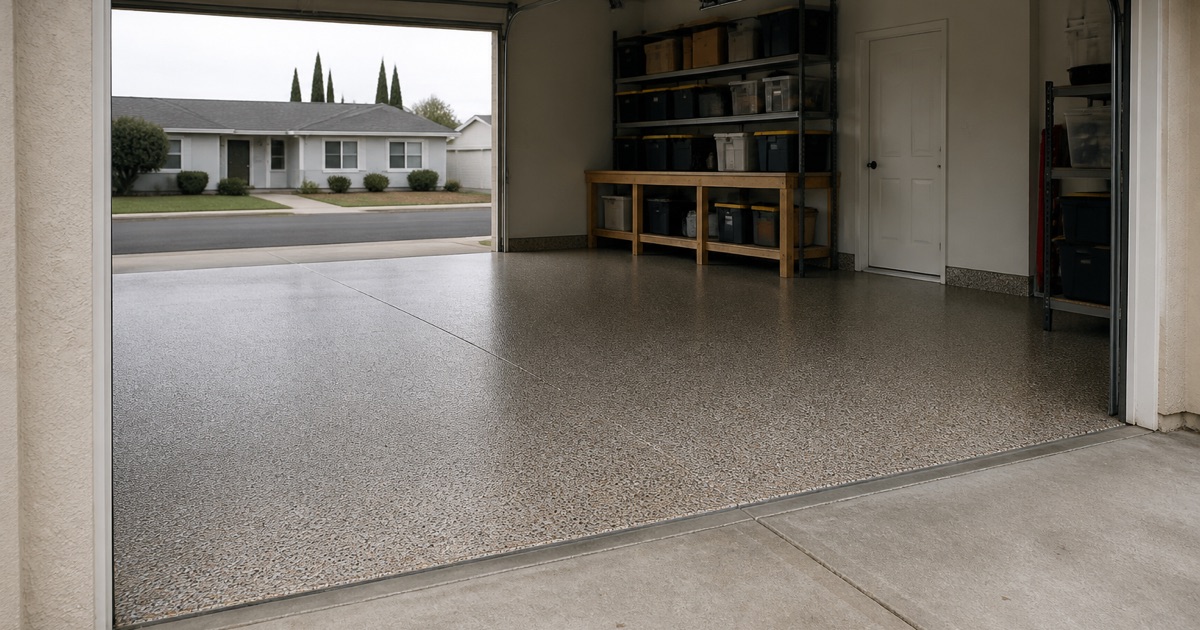
So we lay a vinyl flake broadcast sample directly on the floor in question and leave it there with the door up and the door down. The homeowner picks with their own eyes in their own bay, which is the only condition the finished floor will ever actually be seen under.
Looking for epoxy flooring closer to West Puente Valley? See Epoxy Flooring Services in West Puente Valley.
Dating the slab address by address
Why the tract year is not always the slab year
The stock here is more mixed than a quick look suggests. The 1950s account for 56.5% of units, but a genuine 10.1% dates to 1949 or earlier and another 16.6% went up in the 1960s, with only 5.7% built in 2000 or later. Neighboring communities are far more uniform than this one.
On top of that, garage slabs get replaced, extended and re-poured over the decades in ways the recorded build year never captures. We establish what we are standing on from the concrete itself rather than from the date attached to the parcel, reading joint layout, aggregate exposure and finish texture on site. Two houses on the same block can hand us two different problems.
Moisture on a slab nothing ever required a retarder under
Under-slab vapor retarders were not standard practice for tract construction in the 1950s, and the residential code still exempts garages from the requirement today. The current section calls for a 6 mil polyethylene or approved vapor retarder under a concrete floor slab, then excludes garages, carports and unheated accessory structures outright.
So on a stock that is 88.9% pre-1980, the probability that ground moisture has a clear path up through the slab is high. The reading we take is what decides whether a film-forming system is appropriate at all, or whether a moisture vapor barrier primer coat has to go under the build first.
What the grinder finds underneath
Grinding an old tract slab tends to reveal the history the floor has been hiding. Oil that has soaked deep rather than sat on top, a layer of floor paint from a previous decade, spalling at the door lip where tires have worked the leading edge, and control joints that have opened past their original saw cut are all ordinary findings.
We chase and fill cracks out to sound concrete, patch spalled areas back to plane, and treat joints according to whether they still need to move. A polyurea joint filler goes where movement continues; a rigid fill only goes where it has genuinely stopped.
Getting the crew and the rig onto the street
One route in, and the same route back out
The residential streets here end in cul-de-sacs and do not connect through to the major roads, which keeps traffic out but leaves a single approach to most addresses. Everything funnels onto the same few connectors, with Temple Avenue and Amar Road running east to west and Hacienda Boulevard and Azusa Avenue running north to south.
We check the approach before a date is set. A box truck, a diamond grinder and a dust extraction rig all have to reach the driveway and then leave again, and a turnaround that works on a map does not always work with a trailer behind it.
Staging off the busiest arterials
Hacienda Boulevard, Amar Road, Valinda Avenue and Azusa Avenue are all identified in the county’s Vision Zero Action Plan as Collision Concentration Corridors, carrying a disproportionate share of vehicle collisions. Unloading a rig at the curb on any of them is the higher-risk version of a routine task.
Where an address sits on one of those roads we stage off it, load in from the quieter side street or the driveway itself, and keep the working footprint tight. That is a small planning decision that costs nothing and removes a real hazard from the day.
Containment on a lot with neighbors close by
Houses here sit on modest lots on a community of just over 2 square miles, so anything airborne does not stay on one property for long. We run HEPA dust extraction connected directly to the grinder, collecting concrete fines at the tool rather than letting them find their way outside.
The garage gets sealed at the openings before tooling starts, which keeps the work inside the bay instead of across the yard and the cars. Neighbors on a street this close together notice the difference, and so does the homeowner when the job is done and the driveway is still clean. It also protects the coating itself, since a slab that stays clean through prep is a slab the primer coat can bond to properly.
Product category, permits and the county counter
Keeping the coating on the right side of Rule 1113
This community falls under the South Coast Air Quality Management District, where Rule 1113 holds floor coatings to 50 g/L VOC and allows industrial maintenance coatings up to 100 g/L. Subsection (c)(6) prohibits applying or soliciting an industrial maintenance coating for residential use.
That prohibition is the only side of the line that comes up here. The adopted area plan names no industrial district anywhere inside this community, only limited commercial frontage on Amar Road and Azusa Avenue, so residential product rules govern essentially everything we place on these streets.
Where a permit actually goes
Valinda is unincorporated, so there is no city hall and no city building department to walk into. Building permits, plan check and inspection run through Los Angeles County Public Works, Building and Safety Division, at the La Puente district office on East Central Avenue, which opens at 7:00 a.m. on weekdays.
Land use sits under Title 22 of the county code and the East San Gabriel Valley Area Plan the Board of Supervisors adopted in May 2024. Mail here carries a La Puente address even though the incorporated city next door runs its own separate building division, so we confirm jurisdiction from the parcel rather than from the envelope.
Scheduling against the slab, not the calendar
Pot life is set by the temperature of the concrete rather than by the date on the booking. The same product that allows roughly 60 minutes of working time at 55 degrees can drop to about 20 minutes at 95 degrees, and an uninsulated garage on the valley floor runs well above outside air through a summer afternoon.
We read the slab on arrival and size each batch to what the crew can genuinely spread with a gauge rake and notched squeegee before it starts to set. Every quote carries the product, the mil build and the cure schedule in writing, so the day the car can come back in is a stated date rather than a guess.
- 20+ Years Experience
- Every Slab Moisture Tested
- Written System Spec