
Glendora Epoxy Flooring installs epoxy flooring in Sierra Madre, and we have been building resinous floor systems on foothill concrete for more than 20 years. Most of the work here is a garage bay or a small shared parking area, and most of the planning happens before a single tool comes off the truck. Getting the equipment to the slab is genuinely part of the job in this city.
The technical sequence does not vary. Slab moisture goes on record first, measured with in-situ relative humidity probes to the ASTM F2170 method, because moisture failure is the one thing almost every coating warranty excludes. We open a mechanical profile with a diamond grinder to a named ICRI concrete surface profile rather than acid etching, and the crew that grinds the floor is the crew that puts the topcoat on it.
What sets this place apart is its scale. Sierra Madre covers roughly 3 square miles with no freeway access at all and no traffic lights except at its own boundaries, which is an accurate description of the street network as much as a piece of trivia. Everything we bring in arrives on surface streets that were laid out long before anyone imagined a modern work vehicle on them.
Getting a truck and a grinder onto a village street
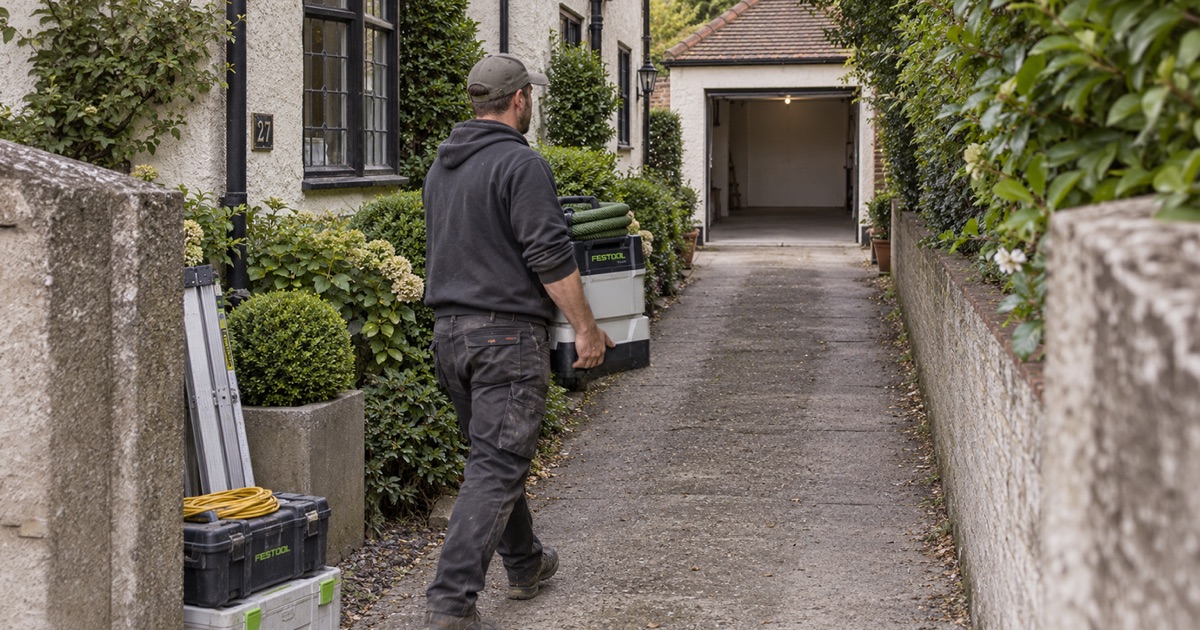
No freeway in, and what that costs a day
Every arrival here is a surface-street arrival. That lengthens the drive at both ends and puts a hard ceiling on how many stops a crew can realistically make, which is why we plan a Sierra Madre job as a day rather than as a slot squeezed between two others.
The upside of committing the whole day is that nothing gets rushed. Prep runs as long as the slab actually needs, the recoat window is respected rather than compressed, and nobody is watching a clock because another address is waiting across the valley. Most of the shortcuts that ruin a resin floor are shortcuts a crew takes because it is already late somewhere else.
Streets that were never widened for a work vehicle
The residential grid below the canyons is narrow, with parking on both sides in most blocks and very little room to maneuver a truck with a trailer behind it. Loading in from the wrong side of a street can block a lane, and blocking a lane on a street this width blocks the whole street.
So we work out the approach, the parking position and the load-in path in advance. That is not fussiness; it is what keeps the equipment moving and keeps us from becoming the reason a neighbor cannot get out of their own driveway. Roughly 28.3% of the housing here sits in structures of two units or more, and shared drives on those properties need the same courtesy applied twice over.
Keeping the working footprint small
A compact setup matters more here than in a place with room to spread out. We stage tightly, keep hoses and cords along one edge rather than fanned across the pavement, and run the grinder shrouded and tied into HEPA dust extraction so the debris goes into the machine.
That containment keeps concrete fines inside the garage rather than across a neighbor’s cars and front walk. On streets where houses sit close together and the sidewalk is a few paces from the bay door, the difference is immediately obvious to everybody nearby.
Looking for epoxy flooring closer to Rowland Heights? See Epoxy Flooring in Rowland Heights.
Canyon addresses that get looked at before they get quoted
Short, steep driveways with nowhere to turn
The northern canyon neighborhoods are hillside development on winding roads under heavy tree cover. Driveways up there are short and steep, frequently shared between properties, and very often offer no turnaround at all once a vehicle is committed to them.
A truck that cannot back out safely is a truck that should never have gone up. We would far rather establish that from the curb than discover it with a loaded trailer halfway up a shared drive with a neighbor waiting behind us.
Surveying the approach before a date is promised
On canyon addresses we look at the access first, in person, before anything is scheduled. The material truck, the diamond grinder and the dust extraction rig each have their own clearance and weight requirements, and all three have to reach the bay and leave it again.
Sometimes the answer is a smaller rig and a longer hose run from a staging point on the street below. Sometimes it changes the day we choose. Either way the owner gets a date we can actually keep rather than an optimistic one.
Slabs that run cooler under the canopy
Pot life on a two-component system tracks slab temperature rather than the calendar, and the same product that allows roughly 60 minutes of working time at 55 degrees can drop to about 20 minutes at 95 degrees. Canyon addresses shaded by mature trees sit well below the flats near Kersting Court on the same afternoon.
Cooler is not automatically easier. A cool slab slows the cure and stretches the recoat window rather than compressing it, so the floor stays vulnerable to anything landing on it for longer, and the schedule has to account for that instead of assuming a fast turn.
Garages holding the whole property’s clearance
A hundred feet of defensible space has to go somewhere
This city sits directly against the foothills and contains Moderate, High and Very High Fire Hazard Severity Zones inside its Local Responsibility Area. Homes in the Very High zone are required to maintain at least 100 feet of defensible space, and the city enforces that locally with periodic inspection.
Everything cleared off a lot to satisfy that requirement has to be stored somewhere, and on most of these properties the garage is the only enclosed space available. The result is bays packed floor to ceiling with material that came off the yard rather than out of the house.
Emptying the bay before the slab is even visible
On those addresses the slab is often not visible at all until the bay is cleared. We say this plainly at the estimate, because the clearing is real work and it belongs in the schedule rather than being discovered on the morning the crew arrives.
We also flag what has to move and what can stay against a wall under protection. An owner who knows the full extent a week ahead can plan for it, and the floor gets a full day of prep instead of half of one. It is also the point at which we measure the bay properly, since a garage packed to the walls hides both its true dimensions and the condition of the concrete underneath.
Days that are wrong for an open coating
Wind-driven fire conditions are not hypothetical here. The January 2025 Eaton Fire prompted evacuation orders in the northern neighborhoods of this city, and an event like that can close access to the upper canyons with no notice while a crew is already working.
Strong wind days are also poor days to hold a garage open for dust extraction or to leave a curing floor exposed to blown grit and ash. We watch the forecast on foothill addresses and move a date rather than gamble a finished surface on it.
Specifying the system for these houses
Older concrete and the reading that governs it
About 79.8% of the 4,977 housing units in this city predate 1980, with 17.6% built in 1939 or earlier and another 12.1% during the 1940s. Slabs from that period generally went in before modern under-slab vapor retarder practice, so ground moisture may have an open route upward.
On that stock the moisture test is a real step rather than a formality. The reading determines whether a film-forming system is appropriate at all, or whether a moisture vapor barrier primer coat has to go down under the build first, and it is recorded on the quote either way.
What the grinder brings to the surface
Opening a profile on concrete this age exposes what has been sitting on it and in it. Old floor paint, oil that has soaked deep rather than pooled, spalling at the door lip and control joints that have opened past their original saw cut are ordinary findings rather than surprises.
We chase cracks back to sound material and fill them, patch spalled areas to plane, and handle each joint according to whether it still needs to move. A polyurea joint filler goes where movement continues, since a rigid patch in that position simply splits along the same line again.
Category, finish and a spec you can compare
This city falls under the South Coast Air Quality Management District, where Rule 1113 caps floor coatings at 50 g/L VOC and permits industrial maintenance coatings up to 100 g/L, with subsection (c)(6) barring the latter from residential use. We select the category against the rule before selecting a color.
Finish choices get made on the actual slab, with a vinyl flake broadcast sample laid in the bay and viewed with the door up and down rather than judged from a chip in a binder. Every quote names the product, the mil build and the cure schedule, and permits, where a project needs them, go through the city’s Building and Safety Division on West Sierra Madre Boulevard.
- 20+ Years Experience
- Every Slab Moisture Tested
- Written System Spec