
Glendora Epoxy Flooring has been installing epoxy flooring in Santa Fe Springs for more than 20 years, and the work here is overwhelmingly commercial. This is a city of working floors: production rooms, packing halls, machine shops and distribution bays, most of them running a shift while somebody is thinking about recoating them.
That changes what a proposal has to answer. Before anyone asks about the finish, the questions are what chemicals hit the floor, how it gets cleaned, who is allowed on site, and when the room can be handed over empty. We build the specification and the schedule around those answers rather than around a product we happened to like.
Every quote still names the product, the mil build, the cure schedule and the return-to-service times, because in a building that has to reopen on a stated shift those numbers are the contract. A coating that is not ready when it was promised is a production problem, not a cosmetic one.
Floors That Sit Next to Food
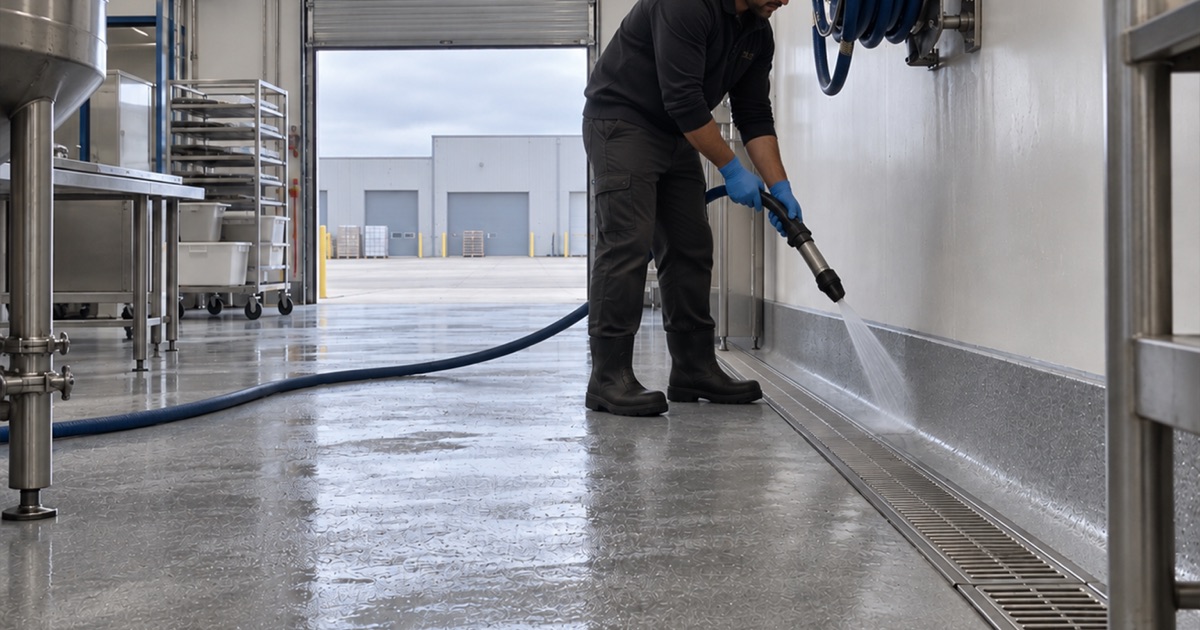
Urethane Cement, Coving and Drainage Falls
Food production is a real vertical in this city — headquarters and plants for grocery and Asian food distribution sit here alongside seafood processing — and a floor in those rooms is effectively a sanitary surface. The specification moves toward urethane cement or a heavily chemically resistant system rather than anything chosen for looks.
The details that matter are the ones at the edges. A cove base carried up the wall removes the dirt-trapping joint where the floor meets it, and falls to drain have to be maintained or improved by the new build rather than flattened out by it. A floor that ponds is a floor that fails an inspection.
Thermal Shock, Washdown and Chemistry
Production floors take punishment ordinary coatings are not designed for: hot washdown, steam, caustic cleaners, acids from the product itself, and the thermal shock of hot water hitting a cold slab. Urethane cement systems exist precisely because that combination destroys standard resins over time.
So we specify against the actual cleaning regime, not a generic one. What temperature is the washdown, what chemistry is in the cleaner, and how often does it happen — those three answers narrow the product list faster than anything else, and getting them wrong is how a floor that looked excellent at handover starts blistering in a year.
Sanitation Shifts and the Inspection Clock
These facilities already have a sanitation window built into their day, and that window is usually when the floor is accessible. It is also short, which means the realistic scope is a phased one: a defined area released, prepped, coated and handed back inside a cure schedule that fits between production runs.
We plan those phases with the plant’s own people rather than proposing a schedule and hoping. A sanitation supervisor knows exactly what can be released and for how long, and the resulting plan is always better than the one we would have written alone.
Looking for epoxy flooring closer to Commerce? See Epoxy Flooring in Commerce.
Badge-In Sites and Escorted Crews
Clearance Lead Times a Residential Job Never Has
Aerospace and defense operations here include some of the largest names in the industry, and their sites do not admit contractors the way an ordinary building does. Access means badges, background paperwork, and a lead time on clearance that has to be started weeks before anyone touches a floor.
We treat that paperwork as part of the project schedule rather than as an afterthought. A crew that cannot get through the gate on Monday is a crew that is not coating anything on Monday, however well the material was ordered.
Working Under Escort
On many of these sites the crew is escorted for the duration, which affects productivity in ways worth being honest about in a bid. Movement between the truck and the work area is controlled, tool and material staging is restricted, and photography is usually prohibited outright.
We price that reality into the labor rather than discovering it on day one and asking for more. An escorted job simply takes longer per square foot than an open one, and a bid that ignores it is a bid that will be revised.
A Named Crew Rather Than a Rotating One
Because clearance attaches to people, the crew has to be fixed in advance and stay fixed. That suits how we already work: one crew takes a floor from the first grinding pass through the topcoat, with no handoff to a subcontractor in the middle.
On a secured site that continuity stops being a preference and becomes a requirement. Swapping in an uncleared installer halfway through a system is not something the site will permit, and it is not something we would ask for.
Distribution Floors That Do Not Stop
Phasing a Running Building
Logistics and wholesale distribution operate on schedules that do not pause for a coating crew, and the honest scope in those buildings is bay-by-bay. A section is roped off and released to us, prepped, coated and handed back before the next shift needs it, and then the next section follows.
That is slower overall than an empty building and it is the only version that actually works. We would rather quote eight phased nights that hold than one weekend that ends with a floor still tacky when the forklifts return.
Nights, Weekends and the Handover Time
Where a full shutdown is possible, it is usually a weekend, and the entire plan hangs on the return-to-service time. Foot traffic and vehicle traffic come back at different points in a cure schedule, and a warehouse cares about the second number far more than the first.
We state both in writing and then schedule backward from the moment the building reopens. Product selection follows from that too, since a fast-cure polyaspartic topcoat buys hours that a slower system cannot, and those hours are sometimes the entire reason a job is feasible.
Access Is the Easy Part Here
One genuine advantage of working in these districts is that they were laid out for trucks. Dock doors, wide aprons and real yard space mean a grinder, a dust extraction rig and a material truck can be staged close to the work without negotiation.
The city sits where I-5, I-605 and I-105 converge, so getting equipment in is straightforward once the timing is agreed. Staging is rarely the constraint on a job here; access authorization and the production calendar are.
The sheer scale of the industrial base is what makes this city unlike anywhere else we work. It holds roughly 55 million square feet of industrial and manufacturing space across more than 3,000 businesses, pulling a daytime workforce of over 30,000 into a city whose resident population was 19,219 at the 2020 census. Extraction from the oil field that made the city’s name in the 1920s still continues today, which tells you how long these blocks have been working ground.
Substrate, Product Category and the Counter
Preparation on a Working Industrial Slab
A slab that has been in service for decades carries contamination, prior repairs and joints that have moved. We open it mechanically, with a diamond grinder running a planned grit sequence or a shot blaster where the area and the profile call for it, and we grind to a named ICRI concrete surface profile written on the specification.
Joints and cracks get handled on their own terms: chased and filled where movement has stopped, honored through the coating where it has not, with a polyurea joint filler where that is the right answer. Spalled areas around dock plates and drains are rebuilt before the system goes down, and dust is pulled at the tool with HEPA extraction so the rest of the building can keep working.
Slab Temperature Inside a Metal-Skinned Building
A warehouse with the roll-up doors open runs hotter at the slab than the air temperature suggests, and that is what governs pot life. On the same product the working time moves from roughly 60 minutes at 55 degrees down to about 20 minutes at 95 degrees, which changes batch size, crew size and how far ahead material can be mixed.
So we take slab readings rather than trusting the forecast, and we schedule against them. On a phased night job in summer that discipline is what keeps a section from gelling in the pail while it is still being spread.
Product Category, the Permit Counter and the Older Half of the City
Santa Fe Springs falls under the South Coast Air Quality Management District, and Rule 1113 caps floor coatings at 50 g/L VOC and industrial maintenance coatings at 100 g/L, with subsection (c)(6) prohibiting the application or solicitation of an industrial maintenance coating for residential use. That line runs in both directions: the product that is correct for a distribution floor here is not lawful to offer for a house, and we name the category on the quote so it is clear which one has been priced.
Where a project needs the city, Building and Safety sits in the Planning and Development Department, working to the 2025 California Building Standards Code. The permit counter runs Monday through Thursday, 7:30 a.m. to 11:30 a.m. and 2:00 p.m. to 4:30 p.m., with City Hall closed on Fridays, so anything requiring an inspection gets planned around a four-day week.
The residential side is smaller but not absent. Of 5,927 housing units, 45.3% were built between 1950 and 1959 and 69.2% before 1980, while 13.0% went up between 2010 and 2019. On the older houses a slab moisture test is a default step rather than an extra, because that concrete predates routine under-slab vapor retarder practice and the reading decides whether a barrier primer belongs under the build.
- 20+ Years Experience
- Every Slab Moisture Tested
- Written System Spec