
Glendora Epoxy Flooring installs epoxy flooring in San Marino, and after more than 20 years of coating concrete across the San Gabriel Valley we can say that the hardest part of a job in this city is rarely the floor itself. It is reaching the floor. The bay usually sits at the far end of a long, narrow property.
So we measure the approach every bit as carefully as we measure the slab. How wide the driveway actually is now, what a gate will allow through, where a vehicle can legally stand, and how far equipment and material have to travel on foot. All of that gets settled before a date is offered to anyone.
The quote then arrives as a written system spec: which product, how many mils of it, and what the cure schedule looks like day by day, with the access plan attached. On a property shaped like this the logistics are half the work, and a price that ignores them is not a price worth relying on.
A driveway built for a car of the 1930s
Sixty-nine percent of the housing predates 1950
40.8% of San Marino’s 4,439 housing units were built in 1939 or earlier and another 28.2% during the 1940s, which puts 69.0% of the city ahead of 1950 and 92.9% ahead of 1980. Single-family detached houses account for 98.6% of the stock, with no mobile homes and no buildings of five units or more.
A house of that period does not come with an attached two-car bay off the front elevation. It has a detached garage set well back on the lot, reached along a side driveway laid out for a car of its own decade. The city was incorporated on April 25, 1913, and most of what stands here went up between 1920 and 1950.
The run has narrowed since it was laid
Those driveways were never generous. Ninety years of mature planting along one side or both, and in many cases a wall or a gate at the street, have closed them in considerably further, and a hedge that has been growing since the 1930s does not leave much margin for a modern vehicle.
This is the one constraint that governs most work in this city, so we measure it rather than assume it. Whether a box truck can reach the bay door, or whether it has to stay out at the curb, decides the crew size, the equipment list and the number of hours. Owner occupancy runs at 82.8% across the city’s 3.77 square miles, so the person walking that driveway with us is almost always the person who owns it.
Carrying the job down the driveway
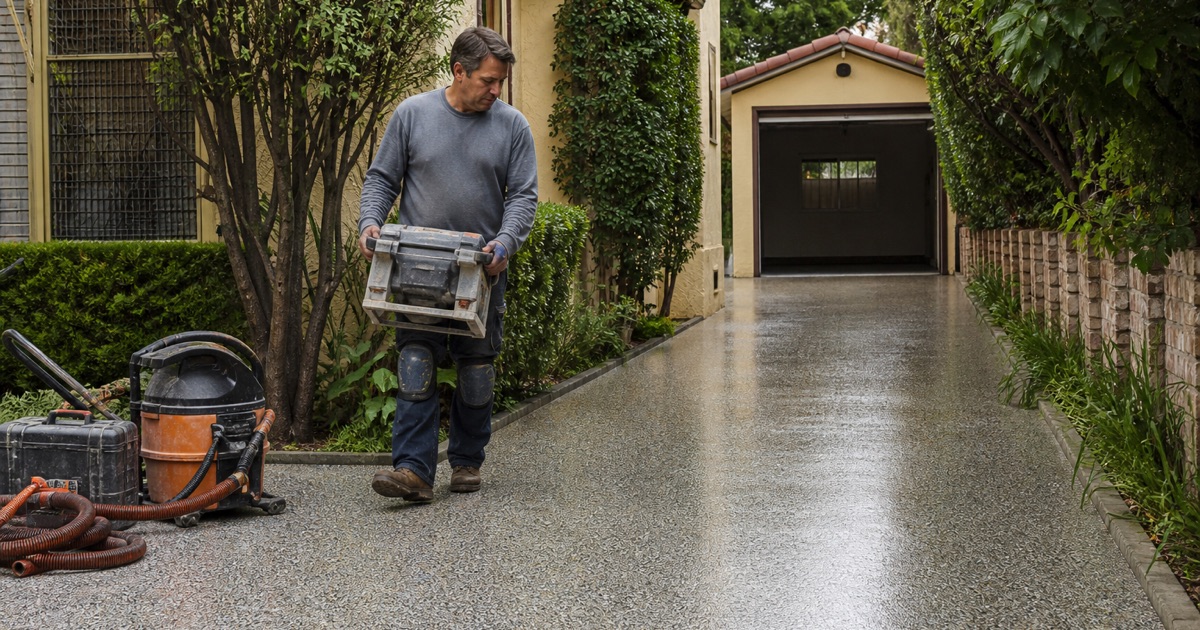
Where the vehicle stays at the street, hoses, power leads and the dust extraction rig are run the length of the property and material is carried rather than wheeled. That is an ordinary day here rather than an unusual one, and we plan the crew around it.
Dust is still captured at the tool with HEPA extraction, which matters more when the route to the bay runs the length of a planted garden. The whole point is to keep the work inside the garage instead of leaving it spread across somebody’s grounds.
Looking for epoxy flooring closer to Santa Fe Springs? See Santa Fe Springs Epoxy Flooring.
Estate outbuildings and the floors inside them
Carriage houses and former chauffeur’s quarters
The pre-1939 stock here includes estate-era outbuildings, carriage houses and former chauffeur’s quarters among them, built as working structures rather than as garages in the modern sense. They turn up often enough that we ask about them early in the conversation.
No two are quite alike. Headroom, doorway width and floor drainage vary from one building to the next, so the specification comes out of the survey rather than out of a standard residential template. Institutional work exists in the city too, with back-of-house shop and storage floors at the Huntington Library on Oxford Road running to a public-institution schedule rather than a household one.
The space above the bays
Many of these outbuildings carry living or storage space over the bays, and that changes how a job is run. Odor, noise and dust all have somewhere to travel upward, and containment has to account for a stair or a hatch that a modern garage simply does not have.
It changes product selection as well. Where a room above is in use, a low-odor build with a fast-return topcoat is worth considerably more than a marginal gain in abrasion resistance, and we will say so rather than quoting the toughest material on the shelf.
Slabs never poured to a garage specification
A floor inside an outbuilding of that age was frequently placed for something other than parking a car — a workshop, a stable, a store. Thickness, surface finish and the fall toward the door all vary, and a good many have been patched more than once over the decades.
We map that before writing a specification. Where a slab is unsound in places, spall repair and crack chasing with polyurea joint filler come first, and where it is genuinely sound we say so instead of inventing repair scope to thicken a quote.
Preparing concrete that is ninety years old
Moisture is a real gate on this stock
Concrete from the 1920s, 1930s and 1940s went down without an under-slab vapor retarder, because the practice did not yet exist. On this stock a moisture reading is a gate the job has to pass rather than a box ticked once the work is already sold.
We use in-situ relative humidity probes read to the ASTM F2170 method, and the figure is written down before a single pail is ordered. Nearly every coating warranty excludes moisture failure outright, so that figure has to exist before the commitment does.
Oil at a depth nobody can see
An unsealed slab parked on since before the war holds decades of oil, and the true depth of that contamination is invisible until a grinder opens the surface. It is the most common reason a schedule on an old bay moves at all.
So we say at the outset that prep scope can grow once we are into the floor, and we agree how that will be handled before starting rather than presenting it as a surprise on day two. A coating laid over contaminated concrete does not stay down, whatever anybody paid for it.
Profile, and what a shaded bay does to the cure
The mechanical profile is opened with a diamond grinder, stepped through a grit sequence until the concrete reaches a named ICRI concrete surface profile. Acid etching plays no part in that, here or anywhere else, because it leaves residue down in the pores rather than taking anything away.
Cure then follows slab temperature. Pot life on a single product covers roughly 60 minutes at a 55 degree slab and around 20 minutes at 95, and a detached bay sitting under mature trees stays at the cool end of that range, which lengthens a cure rather than shortening it.
Working inside the city
Commercial vehicle permits and a city business license
San Marino is one of the few cities in the region requiring commercial vehicles to hold a permit to work within its limits. Every contractor working here must also hold a City business license, and that applies across the trades — construction, plumbing, painting and the rest. The city is restrictive of commercial operations generally, and it enforces that.
That is a step to complete before a truck parks on a street, not paperwork to tidy up afterward. A grinder rig arriving unregistered is a real problem in this city rather than a technicality, so we deal with it in advance as part of scheduling the work.
Design review, and what shows from the street
The city runs strict design review and zoning, with residential land divided into seven tiers by minimum lot size, from around 4,500 square feet up to plots above 30,000. Anything visible from the street on an older property draws more attention here than it would in a post-war tract city.
A garage floor is interior work, but the staging around it is not. We keep equipment, material and waste tidy and out of sight where we can, and we confirm with the owner what is acceptable at the front of the property before the first morning. Commercial activity in the city is confined to Huntington Drive and the Mission Street old town, which is part of why a work vehicle gets noticed here at all.
Permits, and the product the air rules allow
Where a scope calls for a permit, plan check and inspection come from the City of San Marino Community Development Department, Building & Safety Division, at 2200 Huntington Drive. We establish whether a coating scope touches that before quoting rather than afterward.
Product legality gets settled the same way. Under South Coast Air Quality Management District Rule 1113, floor coatings are capped at 50 g/L VOC and industrial maintenance coatings at 100 g/L, and subsection (c)(6) keeps industrial maintenance coatings out of residential use — which in a city that is 98.6% single-family is the binding limit on very nearly every floor we install here.
- 20+ Years Experience
- Every Slab Moisture Tested
- Written System Spec