
Glendora Epoxy Flooring installs epoxy flooring in San Dimas, and we have spent more than 20 years grinding, priming and topcoating concrete across the San Gabriel Valley. The work here divides cleanly between residential garage bays and commercial floors inside venues that operate on a season. Both begin the same way, with a measured slab and a written system spec.
That spec names the product, the mil build and the cure schedule, and it appears on every quote we hand over. It is the only practical way to compare two bids, because without it an owner is choosing between a price and a photograph. With it, the gap between a 100% solids epoxy build and a thin roll-on kit is visible on paper.
One crew carries each floor from the first grinder pass through the clear urethane topcoat, so nothing is handed to a subcontractor between prep and finish. We open the profile mechanically with diamond tooling to a named ICRI concrete surface profile instead of acid etching. HEPA dust extraction pulls debris at the tool, which keeps the job inside the bay rather than across the yard.
Booking a water park deck for the closed season
Why the operating calendar sets the date
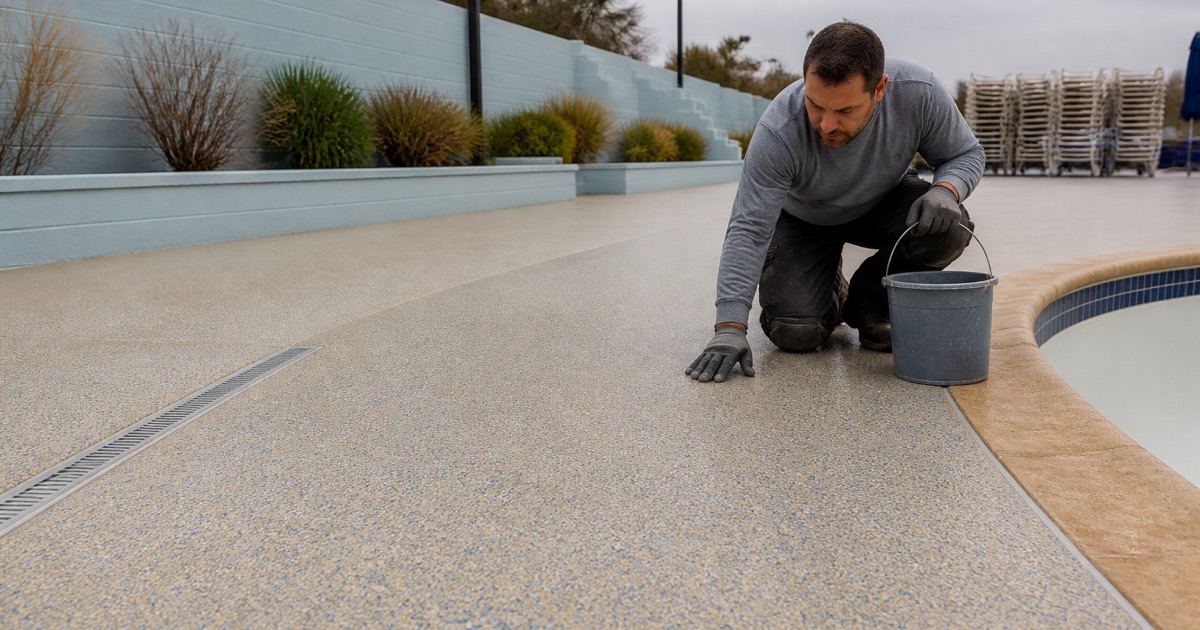
Raging Waters at 111 Raging Waters Drive runs as a seasonal operation, and that single fact governs every coating decision on the property. Deck surfaces, plant room floors and back-of-house concrete cannot be ground and recoated with guests on site, so the work belongs in the closed months. We plan those jobs backward from the reopening date rather than forward from the day the call arrives.
Planning in that direction changes what a realistic scope looks like. A closed window is finite, and a system with a long recoat window consumes more of it than a faster-returning polyaspartic or polyurea build does. We settle the return-to-service date first and let the finish follow from it, rather than the other way around.
Deck, plant room and back-of-house surfaces
Those three areas rarely want the same system, and writing one specification across all of them is cheaper to produce and worse to live with. A wet deck is a slip resistance problem, where an aluminum oxide broadcast matters more than gloss. A plant room sees standing water and chemical contact, and a commissary space behind the scenes may call for urethane cement instead of epoxy.
We survey each space on its own, noting drains, expansion joints, control joints and the condition of any cove base. Each area then gets its own product, mil build and cure schedule on a single document. A facilities manager can see exactly where the money is going and why the numbers differ from room to room.
Sequencing a shutdown so prep is not the bottleneck
Grinding is the loudest, dustiest and least reversible stage of the job, and it is also the stage most likely to expose a problem. Spall repair, crack chase and polyurea joint filler work all reveal themselves during the grind rather than before it. On an off-season schedule we front-load that discovery so any repair still has cure time inside the window.
Containment matters more in a closed venue than most owners expect. Extraction at the tool keeps concrete fines out of pumps, filtration equipment and shuttered food service areas that are switched off but not stripped. It is the difference between one trade working through a shutdown and three trades cleaning up behind it. On a fixed window, that margin is the schedule.
Looking for epoxy flooring closer to Azusa? See Epoxy Flooring in Azusa.
Working to a Los Angeles County contract instead of a city one
Two buyers on either side of the same road
Frank G. Bonelli Regional Park is an 1,800-acre Los Angeles County regional park built around the 250-acre Puddingstone Reservoir, and the water park sits adjacent to it. Floor work on facilities inside the park is a Los Angeles County contract rather than a City of San Dimas one. Different buyer, different approval chain, different paperwork on the way in.
Establishing which of the two you are actually dealing with before a proposal is written saves weeks at the front of a project. A county procurement path carries its own insurance, scheduling and documentation expectations, and a submittal drafted for a private property manager rarely satisfies them. We write to the buyer we are genuinely in front of.
What the city reviews on private work
Inside city limits, private commercial and residential work answers to the City of San Dimas Building and Safety Division at 245 East Bonita Avenue, enforcing the California Building, Electrical, Plumbing and Mechanical Codes. A coating applied over an existing slab is usually not what triggers a permit. The adjacent work an owner bundles alongside it often is.
A new subpanel, added lighting circuits, a floor drain, a utility sink or a mechanical change each pull a review that the coating on its own would not. We raise that at the walkthrough rather than halfway through the job. If an inspection is coming, the schedule should show it before the crew is standing on a bare slab.
Choosing a coating category that is legal for the building
San Dimas falls under the South Coast Air Quality Management District, whose Rule 1113 caps floor coatings at 50 g/L VOC and industrial maintenance coatings at 100 g/L. Subsection (c)(6) bars applying or soliciting an industrial maintenance coating for residential use. Category is therefore a compliance question before it is ever a performance question.
That distinction bites hardest where a residential and a commercial product read almost identically on a data sheet. A material that is legal on a plant room floor is not legal in a homeowner’s garage, and swapping the other direction quietly downgrades what was bought. We name the category on the quote so the choice stays visible.
Tuck-under bays, split-level garages and carports
Surveying the approach before a date is promised
The hillside neighborhoods on the north and west sides of the city, Via Verde among them, sit on sloped lots, and the garages beneath them are frequently tuck-under or split-level. Before a date goes on the calendar we drive the approach and measure it. The truck, the diamond grinder and the dust extraction rig all have to reach the bay.
A steep narrow driveway with a tight turn at the top is not a reason to decline the work; it is a reason to bring different equipment and allow more staging time. What the schedule cannot absorb is a crew discovering the grade on the morning of the grind. Near San Dimas Canyon and the forest boundary, garages also tend to be dense storage first and parking second, and every shelf has to come out before we start.
How a sloped slab behaves under self-leveling material
A tuck-under bay usually carries a deliberate pitch toward the door, and that slope is doing a job. Self-leveling material has no respect for it and will find the low end every time. We build those floors with gauge rake and notched squeegee work at a controlled mil build instead of pouring a product that levels itself.
Spiked shoes and an air-release roller keep the film consistent while it is still workable on a grade. Done properly, the finished floor holds the original drainage line and still reads flat to the eye. Ignore the pitch and a puddle shows up at the door within a season, which is a repair rather than a maintenance visit.
Carports rather than enclosed bays
Mobile homes account for 8.6% of San Dimas housing units, roughly 1,070 of them, and those addresses generally have a carport instead of an enclosed bay. That is a real limit on how much residential garage coating work the city actually contains, and it is worth saying out loud. The single-family figure on its own overstates the addressable pool.
An open carport is a different proposition, because the slab is exposed and the crew has no enclosure to control dust, temperature or debris while a coating cures. Where the conditions will not support a system that lasts, we say so rather than sell a floor that disappoints. Sometimes the honest recommendation is a densifier and a sealer instead of a coating.
1970s and 1980s tract slabs, and what that changes
What a modern-era pour changes about the substrate
Some 63.3% of the city’s 12,370 housing units were built before 1980, and the 1970s is the largest single decade at 32.2%. That is tract construction on relatively modern slabs, which means the substrate usually behaves predictably once the grinder has opened it. Fewer surprises under the profile is the practical benefit of housing that age.
We still measure moisture with in-situ relative humidity probes to the ASTM F2170 method and write the reading down before any material is ordered. That is not suspicion about the concrete; it is that moisture failure is the exclusion in nearly every coating warranty. On this housing stock the test is quick and the number is usually good news.
An owner who decides, and a sample on the actual slab
San Dimas is 72.4% owner-occupied, the highest homeownership rate anywhere on our service map, and 1-unit detached homes make up 61.6% of housing units. The practical effect is that the person asking the questions is normally the person who can authorize the work. Decisions move faster, and there is no third party to route an approval through.
We use that directness by laying flake blends and metallic pigment samples on the customer’s own concrete rather than showing a chip in a binder. Garage lighting is not showroom lighting, and a blend that reads warm on a sample card can fall flat over a gray slab. Choosing on the floor it will live on removes the surprise at handover.
Working to slab temperature instead of the calendar
We schedule against slab temperature rather than the date, because pot life on a single product moves sharply with it. Roughly 60 minutes at 55 degrees becomes about 20 minutes at 95 degrees, and an uninsulated garage here reaches the hot end of that range without much help. Hot-weather work needs smaller batches and a faster crew than the identical job in winter.
A west-facing slab keeps climbing after the air temperature has peaked, so an afternoon start is a different job from a morning start on the same day. We read the slab rather than the forecast, and we check dew point before the topcoat goes down. It is also why the cure schedule is printed on the quote instead of left to assumption.
- 20+ Years Experience
- Every Slab Moisture Tested
- Written System Spec