
Glendora Epoxy Flooring installs commercial epoxy flooring in Pomona, and we have been specifying and placing resinous floor systems across this end of Los Angeles County for more than 20 years. Exposition halls, warehouse aisles, clinical corridors, shop floors and rental garages all run through the same process with us. Whether a floor holds or lifts is almost always decided before the first pail is opened.
That process starts with numbers rather than product names. We measure slab moisture with in-situ relative humidity probes to the ASTM F2170 method and write the reading down before material is ordered, and we open a mechanical profile to a named ICRI concrete surface profile with a diamond grinder rather than acid etching. Every quote names the product, the mil build and the cure schedule, so a building owner can put two bids beside each other and see what actually differs.
The other thing we bring to this city is a realistic idea of what a floor here has to cost. Household budgets in Pomona sit well below those of the hill communities out toward the county line, and a specification written against those budgets simply does not close against these. Pretending otherwise wastes everybody’s afternoon and produces a proposal nobody signs.
Writing a specification that closes at a Pomona budget
Price sensitivity as a design input rather than a discount
Cutting a price is not the same as designing to one. Median household income here is $79,479, while the hill communities toward the county line run past $126,000, so a system that sells comfortably out there can be plainly out of reach in this city. Discounting a specification that was never right for the building only moves the failure a year or two down the road and leaves the owner paying twice.
We start instead from what the floor has to survive and how long it has to last, then work backward to the thinnest honest build that gets there. Sometimes that is a single-coat system with an aggressive prep behind it; sometimes it is a full 100% solids epoxy build under a clear urethane topcoat. The decision belongs to the use case and the budget together, and it is a decision we would rather make in front of the owner than behind a proposal.
Where the money is worth spending on an old slab
About 65.6% of this city’s 44,373 housing units predate 1980, the 1950s alone accounting for 23.3%, and 17.7% went in during 1949 or earlier. Slabs of that vintage were commonly placed without a vapor retarder underneath, and ground moisture then has an open route up into whatever is coated on top.
On that stock the moisture reading is not an add-on line we would like to sell. It is the measurement that determines whether any film-forming system can bond at all, and skipping it to save a small amount at the quote stage is the single most expensive economy available in this market.
A written system spec so two bids can be compared
A price with no system behind it tells a buyer nothing. Two numbers can look a hundred dollars apart and describe completely different work once the mil build, the number of coats and the prep method are written down beside them.
So we put all of it on paper: the product, the solids content, the coats, the recoat window and the day the floor can carry traffic again. Owners in this city tend to be careful with money, and careful buyers are exactly the ones who benefit most from a specification they can hold up against a competitor’s.
Looking for epoxy flooring closer to Monrovia? See Epoxy Flooring in Monrovia.
What a landlord is actually buying
Turnover economics on a rental property
Pomona is 54.0% owner-occupied, which means close to half of the households here rent. On a large share of the residential garage floors we are asked about, the person making the decision is a landlord or a property manager, and their question is not what the floor looks like on move-in day.
Their question is what the slab costs them at every changeover. A sealed, chemically resistant floor that mops clean between tenants removes a recurring line item from the turnover budget, and that is the argument that actually lands with an owner running numbers across several units.
Matching coating life to the re-lease cycle
When a bay changes hands every couple of years, the useful measure is not the maximum life the product datasheet claims. It is how many turnovers the surface gets through before it needs attention, and how disruptive that attention will be when it comes.
We usually recommend a system that can be refreshed with a recoat rather than one that has to be ground off and rebuilt from bare concrete. Keeping the original build sound and adding a topcoat later is a far cheaper cycle for a portfolio owner than a full replacement every time the finish dulls. A polyaspartic or polyurea topcoat also returns the bay to service quickly, which matters when a unit is already listed.
Keeping the product category legal for the property type
Pomona falls under the South Coast Air Quality Management District, where Rule 1113 holds floor coatings to 50 g/L VOC and allows industrial maintenance coatings up to 100 g/L. Subsection (c)(6) prohibits applying or even soliciting an industrial maintenance coating for residential use.
In a city that carries this much genuine industrial stock a short distance from this much housing, that line is a live operational distinction rather than a footnote. We choose the category against the rule and name it on the quote, so a coating destined for a rental garage is one that legally belongs there.
Exposition halls, barns and the buildings around them
Large open spans and equipment traffic
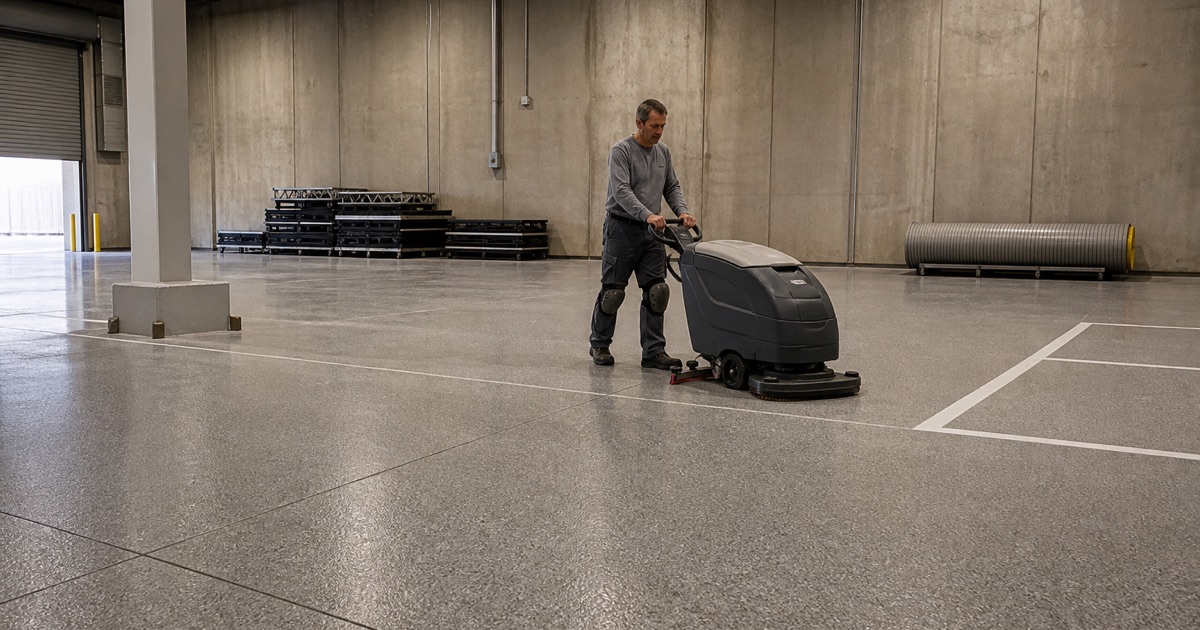
Fairplex is a working year-round exposition venue rather than a fairground that wakes up for a few weeks each September. Its numbered Expo Hall buildings, barns and service structures present a flooring problem with almost nothing in common with a garage bay.
Those are wide uninterrupted spans that take forklifts, scissor lifts, pallet jacks and rolling staging week after week. The floor has to hold up under point loads and hard-wheeled traffic, take safety striping and OSHA aisle marking that stay legible under it, and survive being set up and struck repeatedly.
Wash-down floors in the livestock and service buildings
The animal and service areas on those grounds get hosed down, and a straight epoxy is not the right answer to constant water plus caustic cleaning agents. Urethane cement absorbs that duty far better, and cove base at the wall junction keeps the floor turning up rather than meeting the wall at a seam that traps residue.
Slip resistance matters as much as chemistry on a floor that spends its life wet. A quartz or aluminum oxide broadcast set into the surface gives a DCOF value that a person moving quickly on a damp floor can rely on, which a smooth gloss finish simply cannot.
Routing the work around two national event weekends
The quarter-mile strip on the same grounds at 2780 Fairplex Drive has hosted the NHRA Winternationals since 1961 and the season finale since 2021. Between those two weekends, the test sessions around them and a booking calendar that fills the halls the rest of the year, the venue dictates the work window rather than the contractor.
We plan those projects backward from the first date the space has to be handed back. That means realistic phasing, a cure schedule the venue can actually live with, and a crew sized to finish inside the gap instead of asking for one more day that does not exist. Slab temperature enters that math too, since pot life on the same product runs roughly 60 minutes at 55 degrees and drops to about 20 minutes at 95 degrees in an uninsulated hall.
Old industrial slabs and the institutional floors downtown
Decades of oil in a legacy plant floor
The older industrial buildings along Mission Boulevard carry slabs that have absorbed oil and hydraulic fluid for decades, frequently under two or three earlier coating layers. Preparation on concrete like that is a much larger share of the job than it would be on a newer tilt-up shell.
We say so up front, because an underestimated prep budget is how these projects go wrong. Contamination that is not fully removed will find its way back through a new coating, and the first sign of it is usually a patch of poor pull-off adhesion where nobody expected one.
When shot blasting is the honest answer
A diamond grinder is the right tool on most slabs, but on a heavily saturated or thickly coated industrial floor a shot blaster is often the better one. It removes material faster, opens a deeper profile and reaches contamination that grinding alone will smear rather than lift.
We run HEPA dust extraction at the tool either way, so the debris goes into the machine and not through the rest of the building. On an occupied industrial property that containment is frequently what makes the work possible without shutting neighboring operations down.
Clinical and teaching floors that never fully empty
Western University of Health Sciences on East 2nd Street and the 427-bed acute care hospital in this city both hold floor space where infection control, chemical resistance and coved wall junctions matter far more than appearance. Those buildings run through the night, so the work goes into off-hours windows around a working ward or teaching clinic.
Permits, where a project calls for one, run through the City of Pomona Building and Safety Division inside the Development Services Department. We confirm that requirement before a date is promised, because an institutional shutdown window is not something anyone gets to extend.
- 20+ Years Experience
- Every Slab Moisture Tested
- Written System Spec