
Glendora Epoxy Flooring installs epoxy flooring in Monrovia, and across more than 20 years of coating concrete in the San Gabriel Valley we have rarely worked a city that asks for two answers as often as this one does. There is no single typical Monrovia slab. There are two of them, and they behave nothing alike.
So the first visit is a survey rather than a sales call. We establish when the concrete was poured, what has been done to it since, and who genuinely holds the decision on the property. Only after that do we start talking about systems, finishes and price.
The quote that follows is written as a system spec. It names the product, sets the mil build we are targeting, and lays out a cure schedule you can plan a week around. It is meant to be read closely, including by somebody holding another company’s number alongside it.
Two Monrovias, and why one specification will not cover both
The pre-war core
16.7% of Monrovia’s 14,855 housing units, some 2,484 of them, were built in 1939 or earlier, and 27.9% went up before 1950. That is the oldest core anywhere we work, and it belongs to a city incorporated in 1887 that stands as the fourth-oldest general-law city in Los Angeles County.
Concrete from that period was placed under an entirely different set of assumptions. It predates modern under-slab vapor retarder practice, it has carried eighty years or more of use, and the garage that came with a house of that age is usually not attached to it at all.
The modern build around the station
At the same time, 11.8% of the housing stock has gone up since 2000. A good deal of that sits in the transit-oriented redevelopment around Monrovia station, which opened in 2016 at Duarte Road and Myrtle Avenue on the site of the 1926 Santa Fe Depot that still stands there. The Station Square Transit Village is still adding to that side of the city.
Those floors are a different job in almost every respect. Young concrete, structured or podium parking instead of a private bay, and a management company rather than a homeowner making the call. The finish a board approves is rarely the finish a homeowner picks.
Why a single template fails on this ground
The temptation with any city is to treat it as one era with a long tail behind it. Monrovia does not work that way. It is two separate populations sitting on the same street grid, and a specification written for either end is simply wrong at the other.
The 1950s at 19.4% and the 1960s at 12.3% fill the middle, but they do not blur the two ends into one another. We price a pre-war bay and a post-2000 deck as different categories of work, because that is honestly what they are.
Looking for epoxy flooring closer to Baldwin Park? See Epoxy Flooring Services in Baldwin Park.
Pre-war slabs and the bay at the back of the lot
What sits under concrete poured before 1940
On a slab of that age we test moisture as a real step in the job rather than a courtesy. In-situ relative humidity probes to the ASTM F2170 method produce a number, the number is written down, and no material gets ordered until somebody has read it.
The reasoning is unglamorous. Moisture failure is the exclusion nearly every coating warranty carries, so a system laid over a slab nobody measured is a system nobody has to stand behind. On concrete this old that is not a box to tick.
Prep on eighty-year-old concrete
Old bays come in layers. Floor paint somebody rolled on decades ago, a sealer that gave up, oil driven deep into open pores, and cracking that has been moving with the seasons since before the current owner arrived. All of it has to come off mechanically.
We open the profile with a diamond grinder, running a deliberate grit sequence up to a named ICRI concrete surface profile, and we never substitute acid etching for real texture. Cracks are chased and filled, spalled edges rebuilt, and only then does a primer coat go near the floor.
The detached single bay down a long driveway
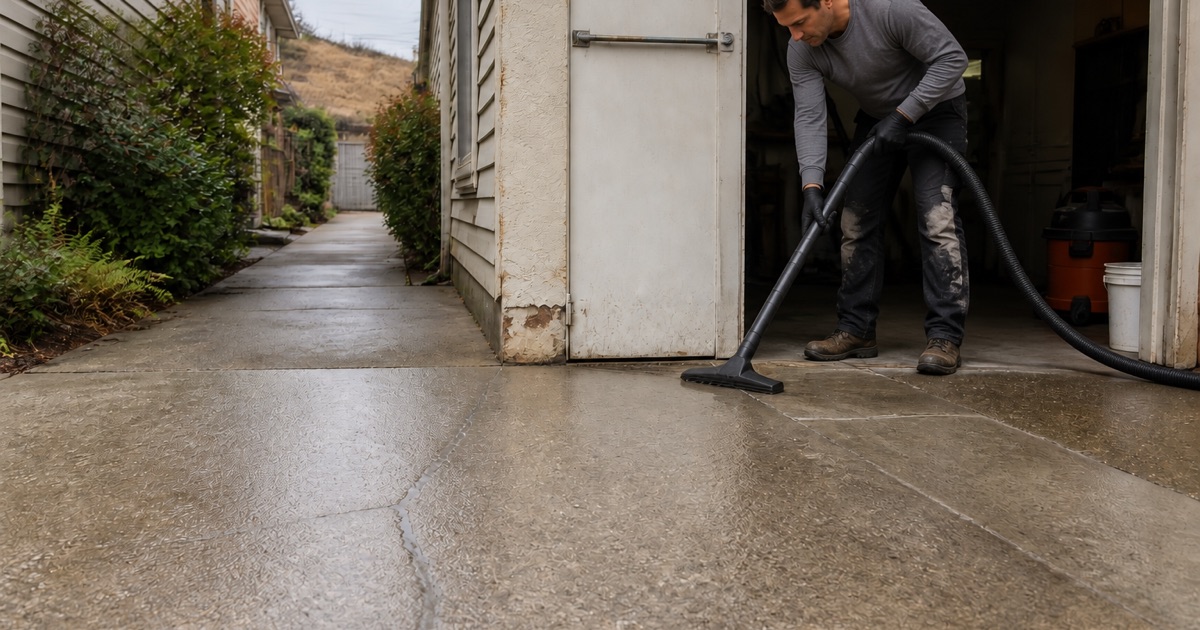
A pre-1940 lot in this city typically puts its garage at the rear, a single bay reached along a driveway that runs most of the property, rather than a two-car bay sitting off the front of the house. That shape settles the logistics before it settles anything else.
It also means a smaller finished floor than an owner has usually pictured, and it means the grinder, the dust extraction rig and every pail of material travel the length of the lot. We measure the bay and walk that route before a date goes on the calendar, so the truck, the rig and the crew are not solving it on the morning of the grind.
When the house is rented, which here is the majority case
Owner-occupied detached is 39.0% of occupied units
Monrovia runs 53.7% renter-occupied against 46.3% owner-occupied, which makes renters the majority. Single-family detached houses are 57.5% of all units, 8,541 of them, but owner-occupied detached amounts to only 5,531 units, or 39.0% of occupied units citywide.
That is the honest shape of this market. The owner-occupied house with its own garage, which is the default customer for a floor coating nearly everywhere else, is a minority of the housing stock in Monrovia rather than the baseline. The remainder of the work sits with landlords, property managers and multifamily owners, and it gets specified accordingly.
Specifying for turnover instead of for one owner
A floor in a rented house has to survive a succession of tenants, not one careful owner. We steer that work toward a 100% solids epoxy base under a clear urethane topcoat, usually with a vinyl flake broadcast, because flake hides the scuffing a rental bay inevitably collects.
Abrasion resistance and slip performance carry more weight there than a showpiece finish does, and the written cure schedule carries more weight still. Property managers schedule against move-in dates, and a move-in date does not shift because a topcoat needs another day.
Working around people who are already living there
Most of these floors get coated with the house occupied. We agree working hours in advance, seal off what has to stay clean, and capture dust at the tool with HEPA extraction so the work stays inside the bay instead of drifting down the driveway and across the cars.
The same small crew is on site from the first grinding pass to the last coat. There is no midway handover to another company, which is what lets us give a tenant and an owner the same start time and the same finish time and mean both.
Above the residential streets: the fire zone and the preserve
Defensible space, and a garage doing double duty
The 1,416-acre Monrovia Hillside Wilderness Preserve, created by a citizen vote in 2000, sits directly above the residential streets, with four public access points open 6:00 a.m. to 9:00 p.m. at the ends of Norumbega Drive, Ridgeside Drive, Cloverleaf Drive and Highland Place. Houses along that edge live with clearance obligations the rest of the city does not.
Monrovia Municipal Code sections 8.14.030 through 8.14.050 set those obligations out: ground within 30 feet of a structure kept clean and green, and hazardous vegetation removed for a minimum of 200 feet around buildings in the Very High Fire Hazard Severity Zone. Where that applies, the garage is usually where everything cleared off the property ends up, so the bay is emptied completely before we ever see the slab.
The 2025 map update, and who administers it
CAL FIRE published updated Local Responsibility Area fire hazard severity zone maps on March 24, 2025, and Monrovia introduced Ordinance No. 2025-08 on June 17 with adoption set for July 1, 2025. The city had historically mapped only a Very High zone; the update adds High and Moderate designations across the east side.
Chapter 7A wildfire-resistant construction standards now reach newly-mapped High-zone properties on new construction and additions, while Moderate-zone parcels carry disclosure alone. The Bobcat Fire burned 278 acres inside the city in September 2020 and held Monrovia under an evacuation warning from September 6 to September 19, which is recent enough that owners here take clearance seriously.
Coating category, and where a permit comes from
Monrovia sits under the South Coast Air Quality Management District. Rule 1113 there holds floor coatings to 50 g/L VOC and industrial maintenance coatings to 100 g/L, and subsection (c)(6) bars the application or solicitation of an industrial maintenance coating for residential use. That ceiling shortens the shortlist well before anyone starts comparing performance.
We settle the category against that rule before anything else, so a house gets a product that is legal in a house. Where a scope calls for a permit it is issued by the City of Monrovia Building Division at 415 S. Ivy Avenue, and fire matters run through Monrovia Fire & Rescue, the city’s own two-station department rather than a county contract.
- 20+ Years Experience
- Every Slab Moisture Tested
- Written System Spec