
Glendora Epoxy Flooring has been putting down epoxy flooring in La Verne for more than 20 years, and a good share of that work sits on slabs the customer does not own. A hangar tenant, a shop operator in a leased unit and a homeowner all want the same durable floor, but only one of them can sign for it without asking anyone. Sorting out who signs is the first thing we do, not the last.
That is why our first conversation here is usually about the building rather than the coating. We want to know who holds title, what the lease or the rental agreement says about improvements, and who has to be satisfied before a crew shows up. Getting that settled early is what keeps a booked date from evaporating a week out.
Once the authority question is answered, the rest is technical and it is ours to solve. Every quote we write names the product, the mil build and the cure schedule, so the person approving the work can see exactly what is going on the concrete. That written system spec matters twice as much when a third party has to sign off on it.
Coating a Hangar Floor You Rent by the Month
Who Owns the Building and Who Wants the Floor
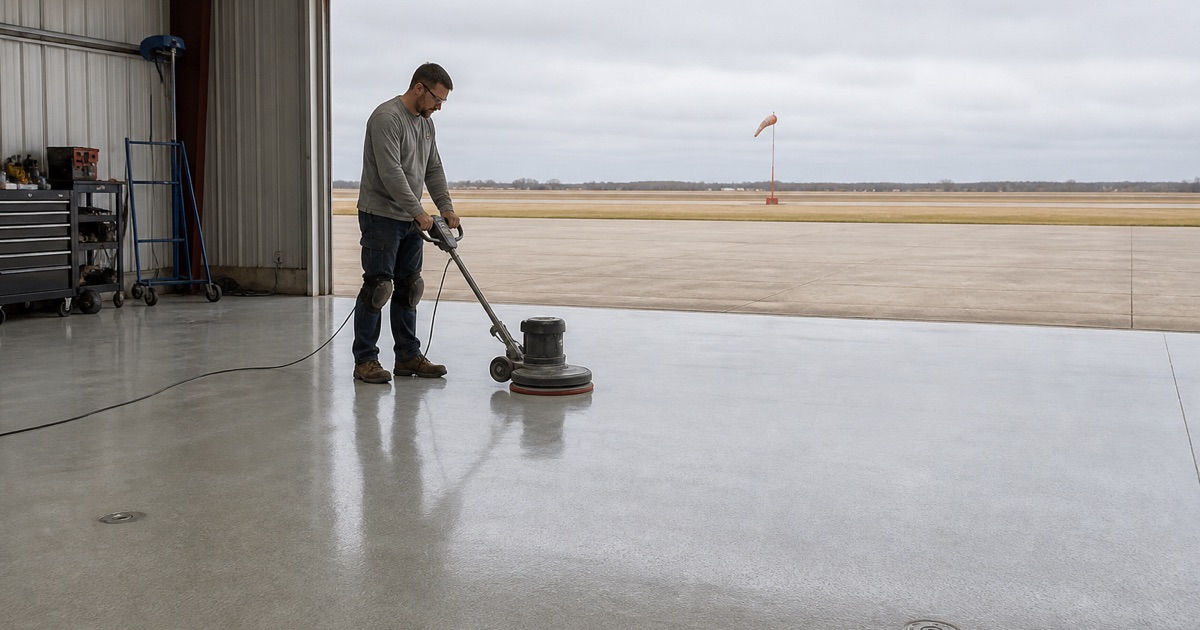
Brackett Field, at 1615 McKinley Avenue, has been owned and operated by Los Angeles County since 1969. It carries roughly forty hangars along with more than a hundred rental sites, and those spaces are rented month to month from Public Works rather than sold. The tenant who parks an aircraft there is renting the building, not owning it.
That single fact reshapes a hangar floor project. The person who wants a clean, chemical-resistant coating is a tenant on a monthly agreement, and the concrete belongs to the county. Any permanent improvement is therefore a request before it is a purchase, and we treat it that way from the first phone call.
Getting Landlord Consent Before a Date Is Booked
We do not put a hangar on the schedule until the tenant has written consent in hand. Booking first and asking afterward is how a crew ends up idle on a Tuesday with a mixed kit of resin that will not keep. Consent first, date second, in that order every time.
What helps is giving the tenant something specific to submit. A spec sheet naming the primer, the finish coat, the total mil build and the cure schedule reads as a defined scope rather than an open-ended alteration, and a defined scope is far easier for a property manager to approve than a vague request to paint a floor.
Why a Month-to-Month Tenancy Changes the Specification
A month-to-month agreement also affects what is worth installing. We will talk plainly about whether a full flake broadcast system is the right spend for a space held on thirty days’ notice, or whether a straightforward pigmented build with a clear urethane topcoat serves the tenant better. That is a judgment call, and it belongs to the tenant, not to us.
What we will not do is quietly install something the landlord would object to. Coatings are effectively permanent once they are bonded to the slab, and removing one means grinding it off. Approval on the front end protects the tenant far more than it protects us.
Looking for epoxy flooring closer to Vincent? See Epoxy Flooring in Vincent.
What a Hangar Slab Has Already Absorbed
Fuel, Hydraulic Fluid and Oil in the Concrete
Hangar concrete lives a harder chemical life than a home garage floor. Fuel spills, hydraulic fluid, solvent and decades of drips soak into the pores, and the contamination is often worst exactly where the aircraft has been sitting. That absorbed material is the enemy of adhesion, because a primer bonds to concrete and not to what is sitting in it.
We assess the contamination before quoting rather than discovering it during the grind. Some of it comes off with the mechanical pass, some needs a localized approach first, and occasionally a badly saturated area is treated as its own line item. Knowing which of those applies changes both the price and the day count, so it is worth the time up front.
Mechanical Prep to a Named Surface Profile
Preparation is done with a diamond grinder running a deliberate grit sequence, stepping to PCD tooling where an old coating or a hardened sealer has to be removed before the profile can be opened. The target is a named ICRI concrete surface profile matched to the system going down, and we write that number on the spec. We do not acid etch, on a hangar floor or anywhere else.
Dust is collected at the tool with HEPA extraction. In a shared hangar row that is not a courtesy, it is a condition of being allowed to work, since airborne concrete dust does not respect the line between one tenant’s bay and the next. Containing it at the source is what keeps a job from becoming somebody else’s complaint.
Metal Buildings, Slab Temperature and Pot Life
A metal hangar heats up faster than the air around it, and the slab underneath follows. Pot life on the same product moves from roughly 60 minutes at 55 degrees to about 20 minutes at 95 degrees, which is the difference between a comfortable spread and a batch that starts to set in the bucket. We schedule against slab temperature, not against the calendar.
In practice that means early starts through the warm months and a smaller batch size when the surface is running hot. It also means we take a reading rather than guessing from the weather app. The same discipline applies to the uninsulated detached garages around town, which behave much the same way on an August afternoon.
Legality, Industrial Space and the Permit Counter
Rule 1113 and the Two VOC Ceilings
La Verne falls under the South Coast Air Quality Management District, and its Rule 1113 sets the ceiling on what may lawfully be applied. Floor coatings are capped at 50 g/L VOC and industrial maintenance coatings at 100 g/L, and subsection (c)(6) prohibits applying or even soliciting an industrial maintenance coating for residential use.
That is a real constraint, not a technicality, and it means the product that suits a working industrial slab is not lawful to offer for a home garage. We pick the coating category against the building it is going into and say which category we are quoting. A contractor who offers you the same higher-VOC product for every address is not reading the rule.
Arrow Highway Industrial Floors and the Shift Window
The industrial corridor along Arrow Highway, together with La Verne Business Park with its truck and container access and La Verne Business Center on First Street near the freeways, runs on schedules that do not pause for a floor. Production keeps moving, and a coating needs its recoat window and its cure time uninterrupted.
So work in those buildings is planned around the operation rather than against it, which usually means nights or a weekend shutdown with a defined return-to-service time. We would rather commit to a realistic window and hold it than promise a fast turnaround and hand back a floor that has not cured.
Booking Around a Four-Day Counter
Where a job needs the city, the authority is the City of La Verne Community Development Department and its Building and Safety Division, and the hours are narrow. Permits are issued Monday through Thursday from 8:00 a.m. to 1:00 p.m., and inspections run Monday through Thursday from 8:00 a.m. to 10:00 a.m.
A two-hour inspection window inside a four-day week is not much room for error. We build that into the sequence from the start rather than treating it as an afterthought, because a missed morning does not simply push a day, it can push most of a week.
Home Garages, Carport Slabs and Park Housing
The Households Without an Enclosed Bay
Not every household here has a garage floor to coat. Mobile homes account for 13.7% of the city’s 12,020 housing units, which is 1,644 homes, and that is a larger share than anywhere else we work. A page written on the assumption that every reader has a two-car bay is talking past a substantial part of the city.
For those households the relevant concrete is usually a carport pad, a patio slab or a walkway, and the honest answer is sometimes that a coating is not the right spend. When it is, the same rules apply: measure it, assess it, and quote a system rather than a gallon price.
What an Exterior Slab Will Actually Take
An exposed carport or patio slab is a different problem from a sheltered garage floor. It sees direct sun, real thermal movement and rain, so the specification leans toward a build with slip resistance worked into the surface and a topcoat chosen for exterior exposure rather than showroom gloss.
We are also candid when a slab is too far gone to be worth coating. Heavy spalling, wide movement cracks or a pad that is actively breaking up is a repair conversation first, and putting resin over it only postpones the same discussion. Most of the housing here is 1970s and 1980s construction, with 62.0% of units built before 1980 and the 1970s alone accounting for 32.3%, so the slabs are generally sound modern pours.
Choosing the Finish on Your Own Concrete
Color and flake get decided on your slab, in your light, not from a chip in a binder. We lay a sample where the floor is actually going, because a vinyl flake broadcast or a metallic pigment reads differently over your gray concrete under a single garage bulb than it does under showroom lighting. It takes an extra visit and it prevents the one complaint that cannot be fixed afterward.
The same crew then carries the floor from the grind through the topcoat. Nobody hands the slab to a subcontractor between the preparation and the finish, which is the seam where most of the failures we get called to repair originally started. One crew, one spec, one set of people accountable for the result.
- 20+ Years Experience
- Every Slab Moisture Tested
- Written System Spec