
Glendora Epoxy Flooring installs epoxy flooring in La Puente, and we have been placing resinous floor systems on San Gabriel Valley concrete for more than 20 years. Garage bays make up most of that work here, along with retail back-of-house floors and small commercial spaces. In every case the slab decides the system, and the system gets written down before anything is ordered.
Our sequence is fixed. Slab moisture is measured with in-situ relative humidity probes to the ASTM F2170 method and the reading goes on paper, because moisture failure is the exclusion buried in nearly every coating warranty. The profile is opened mechanically with a diamond grinder to a named ICRI concrete surface profile rather than acid etching, and one crew carries the work from that first pass through the final topcoat.
Two things about this city change how we plan a job before we ever pick a product. The first is that its 3.48 square miles interleave with the City of Industry and with unincorporated county on almost every side. The second is that 50.9% of the housing stock came out of a single decade, which makes far more of the work predictable than it would be almost anywhere else in the valley.
Which counter an address actually reports to
A mailing address is not a jurisdiction
A great many properties carry a La Puente mailing address without sitting inside the city at all. Run a handful of addresses on the same arterial through a geocoder and they come back in different jurisdictions: some inside the city, some inside the City of Industry, some in unincorporated county territory.
That matters because the agency issuing a permit changes with the parcel, not with the postmark. Two properties a block apart can answer to two different building departments, and the one that is technically outside the city limits gives no outward sign of it. We resolve the jurisdiction from the address before quoting, so nobody discovers on inspection day that the paperwork went to the wrong counter.
A small counter with narrow hours
The city’s Building and Safety Division works out of City Hall on East Main Street, and over-the-counter plan check runs Mondays and Thursdays from 10:30 a.m. to 12:00 p.m. and Tuesdays from 2:30 p.m. to 4:30 p.m. That is a considerably narrower window than a full-time division keeps.
The building official and plans examiner are provided under contract rather than being career city staff, which is common for a city this size and works perfectly well. It does mean the counter schedule is real and not a suggestion, so a submittal missed on a Thursday morning waits for the following week.
Confirming all of it before a date is promised
Most residential garage coating work does not require a permit, but commercial tenant improvements and anything touching drainage, structure or occupancy frequently do. We would rather establish which category a project falls into at the estimate than partway through a shutdown.
So the jurisdiction check and the permit question both happen up front, alongside the moisture reading and the slab measurement. It costs an hour early and it prevents the kind of delay that has no good explanation once a floor is already torn up.
Looking for epoxy flooring closer to Montclair? See Montclair Epoxy Flooring.
Half the city out of one decade
What a single dominant vintage makes predictable
Of the 9,958 housing units here, 5,069 were built in the 1950s, with another 13.9% from the 1960s and 8.9% from the 1970s. Just 5.1% went up in 2000 or later. That concentration is unusual, and it means the bay we walk into today tends to resemble the one we finished last week.
That repeatability is genuinely useful. Slab thickness and finish, the slope toward the door, the depth of the original saw cuts and the way the driveway meets the apron all recur, so our estimates hold and our scheduling assumptions hold with them. A city built out across four separate decades gives a contractor none of that, and the quotes coming out of it are correspondingly looser.
Where the repetition stops
What does not repeat is what has happened to the concrete since. Seventy years of oil, floor paint, a home workshop, a rented tenant period or a slab extension added at some point along the way all leave different problems on identical original construction.
So we still walk the bay before quoting. We look for spalling at the door lip, cracks that have moved, joints opened past their original width, and prior coating that has to come off rather than be coated over. Cracks get chased out to sound concrete and filled, and a joint that still moves takes a polyurea joint filler instead of a rigid patch that will simply split along the same line again.
The finished floor is smaller than owners picture it
A two-car bay from this era is narrower than a modern one, and that surprises people. Once the water heater platform, the shelving run and the workbench are subtracted, the coatable area is meaningfully less than the number a homeowner had in mind from the outside dimensions.
We measure post-war garages before quoting anything for exactly this reason. A square footage taken off the actual slab is a number that does not move later, and it also lets us size the flake broadcast and the material order accurately the first time.
Slabs poured before the modern vapor retarder specification existed
ASTM E1745 came along much later
ASTM E1745, the standard specification for plastic water vapor retarders used under concrete slabs, was first published in 1997. Every slab from the decade that built half this city predates that specification by roughly forty years, and the practice it describes was not the norm when they were poured.
That does not automatically mean a slab is wet. It means the question is genuinely open on 81.1% of the housing here, and that an assumption in either direction is a guess with somebody’s floor riding on it.
What the reading decides
The relative humidity probes go into drilled holes and are left to equilibrate before we read them, and the result goes on the quote in writing. That number is what selects the system, not a preference and not what was used on the last job.
A high reading pushes us toward a moisture vapor barrier primer coat under the build, or occasionally toward advising against a film-forming system entirely. Both are unwelcome answers, and both are cheaper than a coating that lifts off the slab in its first year.
Preparation on concrete this age
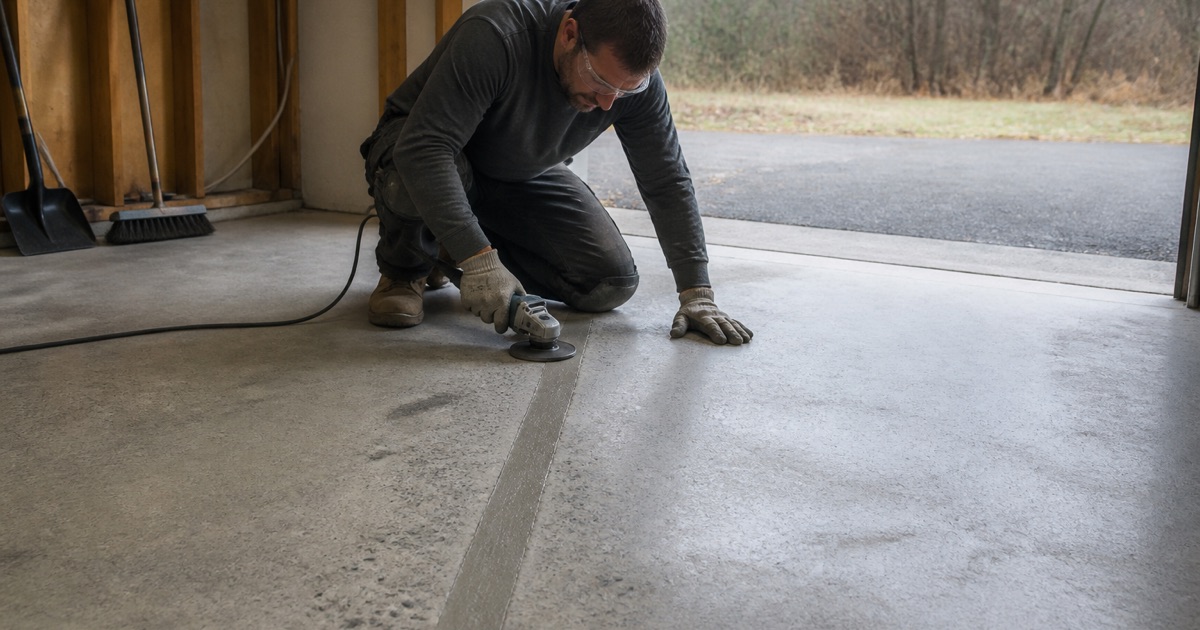
We open the profile with diamond tooling, stepping through a grit sequence appropriate to what the slab turns out to be and what is already stuck to it. Acid etching does not produce a consistent mechanical profile and we do not use it.
Dust gets collected at the tool through HEPA extraction rather than chased around afterward, which keeps concrete fines inside the garage instead of drifting across the yard and the cars. On the compact lots typical of this stock, that containment is what makes a full grind acceptable to a household. It also protects the work itself, since the primer coat can only bond to a surface that is still clean when it goes down.
Valley floor conditions and the floors that come with them
What the terrain here rules out
City Hall sits at roughly 334 feet of elevation and the ground across the city is essentially flat. Every point sampled inside the city classifies as NonWildland in the county fire department’s hazard severity zone layer, and fire response comes from the Los Angeles County Fire Department out of Station 26 on East Elliot Avenue.
So the foothill complications simply do not arise here. There is no steep approach to survey and no brush clearance condition attached to the property, which removes a whole category of scheduling risk from a job in this city.
Commercial work here is usually retail, not distribution
The city describes itself as roughly 70% residential with industrial development under 5% of its land area, and it carries a single industrial zoning designation. Retail accounts for 22.2% of the jobs located inside the city, well ahead of manufacturing.
So a commercial floor inquiry here is far more often a shop, a restaurant back-of-house or a tenant improvement than a large industrial bay. Those jobs turn on fast return to service, cove base at the wall junction, and a DCOF slip rating that holds up where the floor gets wet. A polyaspartic or polyurea topcoat frequently earns its cost on those projects purely by shortening the closure.
Category, spec and the temperature of the slab
This city falls under the South Coast Air Quality Management District, where Rule 1113 caps floor coatings at 50 g/L VOC and allows industrial maintenance coatings up to 100 g/L, with subsection (c)(6) barring industrial maintenance coatings from residential use. We choose the category against the rule and name the product on the quote.
We also schedule against slab temperature rather than the calendar, because pot life on the same product runs roughly 60 minutes at 55 degrees and falls to about 20 minutes at 95 degrees. Every quote carries the product, the mil build and the cure schedule, so two bids can be compared on the same terms and the return-to-service date is a written commitment.
- 20+ Years Experience
- Every Slab Moisture Tested
- Written System Spec