
Glendora Epoxy Flooring installs epoxy flooring in Commerce, and after more than 20 years of coating concrete across Los Angeles County we approach this city as a warehouse and plant market rather than a residential one. The work here is cross-dock slabs, transload bays, production floors and public-facing spaces that cannot simply close. That shapes everything about how a job gets planned.
So the first question is never which product goes down. It is when the floor can be taken out of service, for how long, and what has to be true before it goes back. We work backward from that answer, through the cure schedule and the recoat window, to the hour the grinders are scheduled to start.
Every proposal carries a written system spec naming the product, the mil build and the cure schedule, so a facilities or operations manager can compare two submittals on substance. Preparation is mechanical: a diamond grinder or shot blaster opens a named ICRI concrete surface profile, and HEPA extraction collects dust at the tool. One crew runs the floor from prep through to the topcoat.
Finding downtime in an operation that has none
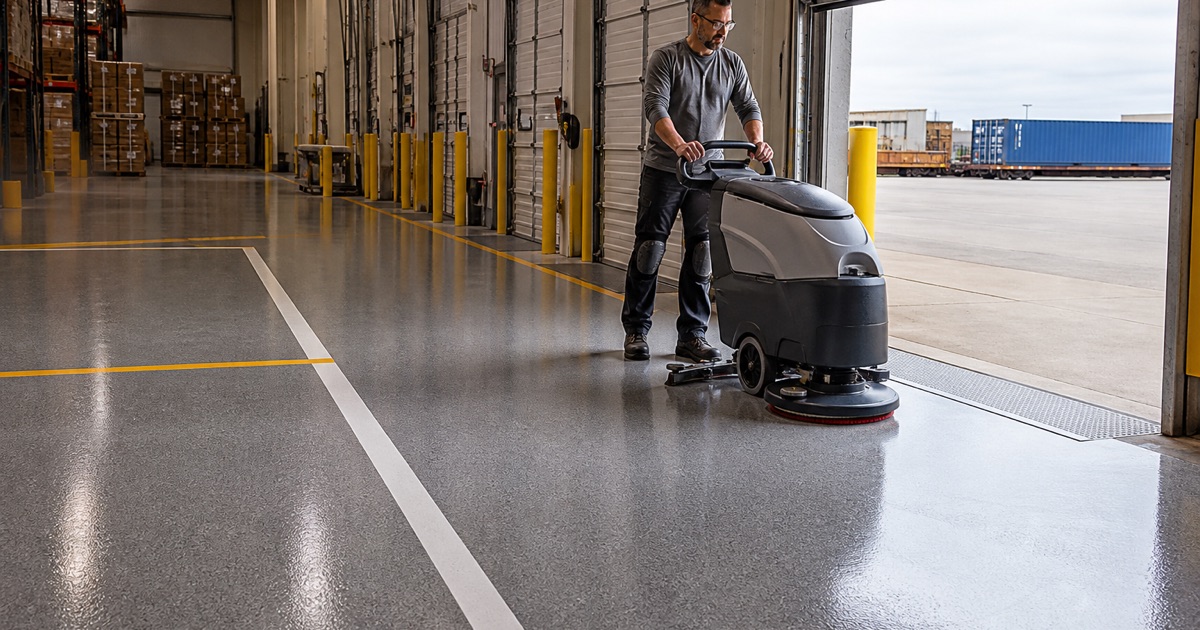
Hobart’s clock, and the buildings that match it
The BNSF Hobart intermodal facility is the largest rail intermodal operation in North America — 243 acres, roughly 52,000 feet of production track, 30 cranes, 2,200 wheeled parking stalls and 1,475 on-site stacking spaces, handling up to 1.5 million lifts a year. It runs around the clock. The warehousing built around it runs to match, which means there is no quiet week waiting to be used.
That is the single fact a contractor has to design around in this city. A building tied to that chain has no natural downtime; downtime has to be manufactured, agreed and paid for. We treat the window as the hardest constraint on the job and everything else as negotiable around it.
A shutdown window, or phasing bay by bay
There are two honest ways to coat a floor that cannot stop. The first is a genuine shutdown, usually over a holiday or a planned maintenance period, where the area comes out of service all at once. The second is phasing, where the floor is divided and each section is closed, coated and returned while the rest of the building keeps working.
Phasing costs more crew time and produces cold joints between sections, which have to be placed deliberately rather than wherever a shift happened to end. We plan those breaks at layout stage so they land on lines that make operational sense — aisle edges, rack lines, the boundary of a staging area — instead of leaving a visible seam across a traffic lane.
Return to service as the design constraint
Once the window is fixed, the system follows from it rather than the reverse. A fast-return polyaspartic or polyurea build can hand a floor back in a fraction of the time a heavy epoxy system needs, and on a tight window that difference decides the specification outright. Where the window is genuinely long, a 100% solids epoxy base under a urethane topcoat is often the better floor.
We put the cure schedule and the recoat window in writing on the proposal for exactly that reason. An operations manager committing to a reopening time needs those numbers in front of them rather than a verbal assurance. If the arithmetic does not close, we say so before the work is booked instead of afterward.
Looking for epoxy flooring closer to La Cañada Flintridge? See Epoxy Flooring Services in La Cañada Flintridge.
Cross-dock, transload and 3PL floors
Dock aprons, staging bays and a slab that runs hot
A cross-dock apron and a staging bay take different abuse from the same building’s office corridor. Forklift traffic, pallet drops and steel wheels concentrate wear along the dock line, so mil build and abrasion resistance matter more there than anywhere else on the slab. We specify by zone rather than coating a whole building to a single number.
Temperature is the other zone problem. With dock doors open, the slab inside a metal building runs well above the air temperature, and pot life on the same product falls from roughly 60 minutes at 55 degrees to about 20 minutes at 95 degrees. Batch sizes come down and the crew moves faster, or the material sets in the bucket.
Joints, saw cuts and the point loads that find them
Expansion joints and control joints are where an industrial floor fails first, because every wheel crossing one loads the edge. Bridging a moving joint with coating guarantees a crack, while ignoring a dormant saw cut leaves a debris trap in the middle of a traffic lane. We fill dormant cuts with polyurea joint filler and keep working joints honest through the finished surface.
Spall repair around the dock edge and along rack lines belongs in the same pass. Those areas have usually been struck repeatedly and patched informally over the years, and coating over a loose repair fails within the first month. We take out what is failing rather than sealing it in, even when that adds a day.
Safety striping and aisle marking as part of the system
Pedestrian lanes, aisle boundaries and hazard markings work far better built into the coating than painted on afterward. Applied as part of the system, they cure with the floor, wear at the same rate and survive the cleaning equipment that would strip surface paint within a season. That is a maintenance saving as much as a safety one.
It does have to be laid out before the topcoat goes down, which means the layout conversation happens at proposal stage rather than at the end of the job. We ask for the racking plan and the traffic pattern early on. Marking a floor that is about to be re-racked wastes everybody’s time.
Washdown, thermal shock and food plant floors
Urethane cement where epoxy will not hold
Food manufacturing is a genuine vertical in this city, and those plants run floors that a decorative epoxy has no business being on. Hot washdown, caustic cleaning chemistry and thermal shock at the drain will lift a standard epoxy system off a slab. Urethane cement handles that temperature swing and that chemistry in a way epoxy does not.
The decision comes from what actually happens in the room, not from the building’s use classification. A dry storage area and a cook line inside the same plant want different systems, and specifying one product across both is precisely how a floor fails in the place it matters most. So we survey room by room.
Cove base, drains and falls
In a wet plant the perimeter and the drainage are the specification. An integral cove base carries the coating up the wall so there is no floor-line seam holding water, and the falls have to genuinely deliver liquid to the drain instead of to a low spot a few feet away. Standing water is where sanitation problems begin.
We terminate into drains properly, detail the cove at every corner and check the falls before the first coat rather than discovering them afterward. Where the room’s use requires slip resistance, an aluminum oxide broadcast sets the DCOF without making the floor impossible to clean. Grip and cleanability pull against each other, and finding the balance is a specification decision.
Sanitation-shift access and inspection sensitivity
Access in a food plant usually means working alongside or immediately after a sanitation shift, in a space that has to be handed back inspection-ready. That is a different discipline from an empty warehouse, and it is not one a crew can improvise. Containment, tool cleanliness and a documented sequence matter as much as the coating itself.
Extraction at the tool is not optional in that environment, because concrete dust in a production space is a contamination event rather than a cleaning task. We contain the work area, control traffic in and out, and hand back a floor a quality manager can sign for. The schedule gets built around their calendar, not ours.
The city around the yard
The 5, the 710 and the 60
Commerce sits at the junction of the I-5, the I-710 and SR-60, with port drayage traffic running straight through it. Once a crew is on site the work itself is straightforward, because industrial parcels have yard space and dock aprons to stage from. Getting there and back at the wrong hour is the difficult part.
So we plan arrivals and material deliveries around the peaks rather than into them, and we build that honestly into the quoted hours. A truck sitting in drayage traffic is not a crew grinding a floor. On phased work in particular, one slipped arrival compounds across every section that follows it.
Building and Safety on Commerce Way
Permits, plan check and inspection run through the City of Commerce Building and Safety Division, within the Department of Economic Development and Planning at 2535 Commerce Way. From January 1, 2026 plans are checked against the 2025 California Building, Electrical, Green, Mechanical, Plumbing and Residential Codes. On a coating scope, that generally matters through the work bundled alongside it.
New floor drains, a trench modification, added circuits for equipment or a mechanical change can each pull a review the coating alone would not. On a phased industrial project that review has to be sequenced against the shutdown windows rather than discovered inside one. We identify it during the walkthrough, before dates are committed.
Under 12,000 residents, and where Rule 1113 lands
There is a residential side to this city, but it is small: 3,381 housing units, 64.5% of them detached, and 57.1% built before 1960. Slabs of that age carry moisture questions and long-accumulated oil contamination, so in-situ relative humidity testing to the ASTM F2170 method and real remediation are line items on that work rather than exceptions to it.
The two markets sit within a block of each other, which keeps coating category a live question every working day. Rule 1113 from the South Coast Air Quality Management District caps floor coatings at 50 g/L VOC and industrial maintenance coatings at 100 g/L, and subsection (c)(6) prohibits applying or soliciting an industrial maintenance coating for residential use. The same crew carries both product lines and never crosses them.
- 20+ Years Experience
- Every Slab Moisture Tested
- Written System Spec