
Glendora Epoxy Flooring has been installing epoxy flooring in Citrus for more than 20 years, and on this stretch of unincorporated Los Angeles County the work almost always begins the same way. We measure what is moving up through the slab before we quote anything that goes on top of it. That order is deliberate, because on concrete of this age the moisture reading decides the system, not the other way around.
Moisture is also the one condition that nearly every coating warranty excludes, which means the manufacturer has already decided who carries that risk. We would rather find the number early, write it on the quote, and specify a build that can live with it. A resin that is wrong for a damp slab does not announce itself for months, and by then the only honest repair is to grind the entire floor off and start again.
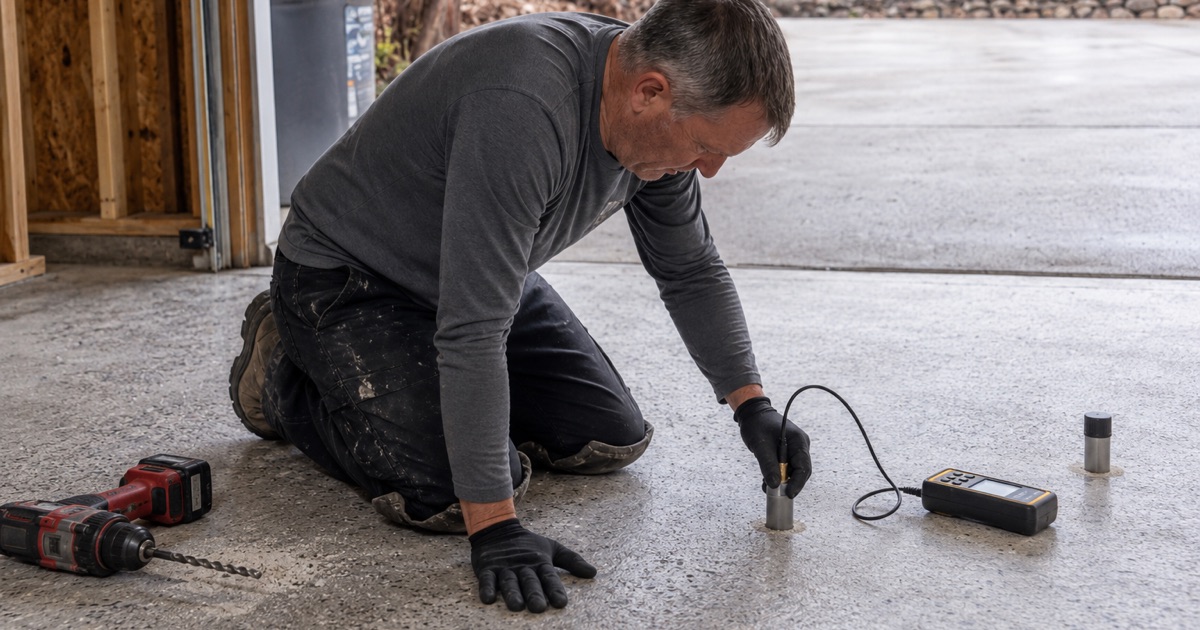
So every job here opens with a slab moisture test run to the ASTM F2170 method, using in-situ relative humidity probes drilled into the concrete rather than taped to the surface of it. The reading is written down before a single pail is ordered. What the probes report then drives the primer, the mil build and the cure schedule that appear on the written system spec we hand you.
Why the Moisture Test Comes Before the Quote
The Reading That Gets Recorded Before Material Is Ordered
Ordering resin first and testing afterward is backwards, because the test result can change which product category is appropriate. A slab that reads high needs a moisture vapor barrier primer underneath the build, and that decision affects the price, the number of days on site and the cure schedule. Finding it out after the material is on the truck helps nobody.
We put the probes in, let them equilibrate as the method requires, and record the result against the address. That number goes onto the proposal alongside the product name, the mil build and the recoat window. Two bids written that way can actually be compared against one another, which is rarely true of the one-line quotes homeowners are usually handed.
Where the Pass-or-Fail Threshold Actually Lives
A point that trips up a lot of people: neither ASTM F1869 nor ASTM F2170 tells you whether your slab passes. Those documents describe how to run the test and how to report the result, and nothing more. The acceptance thresholds sit in ASTM F710, the standard practice for preparing concrete to receive resilient flooring.
That distinction matters when a contractor waves a test slip at you. A number without the threshold it is being judged against is just a number, and a coating manufacturer’s own data sheet may set a stricter limit than the general practice does. We tell you which document we are reading the result against and which limit the chosen product carries.
What the Warranty Quietly Leaves Out
Read the exclusions on almost any garage floor coating warranty and moisture-related delamination will be sitting there, carved out. That is not a trick; it is an acknowledgment that the coating cannot control what the concrete is doing underneath it. The manufacturer covers the film, and the slab is somebody else’s problem.
We treat that as the reason to test rather than the reason to skip it. If the reading is high, we say so, and the options are a barrier primer, a different resin chemistry, or a decision not to coat that particular bay at all. None of those conversations get easier by having them after the floor has already lifted.
Looking for epoxy flooring closer to San Dimas? See San Dimas Epoxy Flooring.
Two Ways to Measure a Slab, and What Each One Answers
Calcium Chloride and the Moisture Vapor Emission Rate
The calcium chloride test, ASTM F1869, weighs a dish of salt over a sealed area of the floor and reports a moisture vapor emission rate, or MVER. It is an old method and a familiar one, and it describes what is leaving the surface of the slab during the test window.
Its weakness is depth. It reads the top layer, so a slab that has been sitting under a closed garage door in dry weather can present better than it is. On a seventy-year-old pour with no reliable barrier beneath it, a surface-only picture is not enough to specify against.
In-Situ Relative Humidity Probes and What They See
The ASTM F2170 method drills into the slab and sets a probe at a defined fraction of its depth, then leaves it to come to equilibrium before the reading is taken. That gives a relative humidity value from inside the concrete, closer to what the slab will do once a coating seals the top of it.
This is the method we lead with in Citrus, and the reason is the housing stock rather than a preference for gadgets. When the slab is the variable most likely to end the job early, the deeper measurement is the one worth paying for. We drill, we wait the required period, and we record what the probe says instead of what the calendar wants it to say.
The Plastic Sheet Test and Its Limits
ASTM D4263, the plastic sheet method, is the tape-a-square-of-poly-down check some crews still use. It can confirm that obvious moisture exists, and that is genuinely useful as a first look on a slab nobody has assessed before. What it cannot do is produce a number you can specify a coating against.
So we use it the way it deserves to be used, as a quick indicator rather than as the basis of a decision. When a floor is going to carry a 100% solids epoxy primer and a clear urethane topcoat over it, the specification needs a measured value, not an impression of one.
Slabs Poured Before Under-Slab Vapor Retarders Were Routine
What Sits Under a 1950s Pour
Garage slabs from this era were generally placed on grade with whatever the practice of the day called for, and modern under-slab vapor retarder detailing was not yet part of it. That does not make the concrete bad; plenty of it has outlasted the coatings people have put on it. It does mean the slab has a route for ground moisture that a current pour would not have.
Characterizing it that way is honest, and it is also exactly why we do not guess. Two houses on the same block can read differently depending on drainage, shade and what the previous owner did to the yard. The probe settles the argument in a way that assumptions about the era never will.
Choosing a System the Reading Will Actually Allow
When the number comes back elevated, the response is a moisture vapor barrier primer under the build, and then the finish system on top of that. When it comes back comfortable, we can go straight to a 100% solids epoxy base and a polyaspartic or clear urethane topcoat without the extra layer and the extra day. Either way the choice traces back to a measurement.
Product legality is checked at the same time. Citrus falls under the South Coast Air Quality Management District, whose Rule 1113 caps floor coatings at 50 g/L VOC and industrial maintenance coatings at 100 g/L, and subsection (c)(6) prohibits applying or even soliciting an industrial maintenance coating for residential use. A garage on a residential lot here gets a floor coating category product, and we will not offer otherwise.
One Slab Generation Across the Whole Community
Citrus is unusually consistent for a Southern California community. Of its 2,740 housing units, 92.0% were built before 1980 and 65.3% went up in the single decade from 1950 to 1959, with 88.5% of the stock being one-unit detached homes. Only 1.6% has been built since 2000 and nothing at all since 2010.
That uniformity is worth something on a job. The same pour generation, the same bay proportions and the same seventy years of wear repeat street after street, so what we learn on one floor carries forward to the next in a way it simply does not in a mixed-era city.
Being an unincorporated CDP rather than a city, Citrus has no local permit counter of its own. Building and safety for the area is handled by Los Angeles County Public Works out of the San Gabriel Valley district office at 125 South Baldwin Avenue in Arcadia. And despite the shared name, Citrus College sits inside the City of Glendora rather than in the CDP itself.
Seventy Years of Wear on the Same Concrete
Diamond Grinding to a Named Surface Profile
Preparation here is mechanical, always. We open the slab with a diamond grinder, working a deliberate grit sequence and moving to PCD tooling where an old sealer or a stubborn coating has to come off first. The target is a named ICRI concrete surface profile appropriate to the product going down, and it is written on the spec so there is no argument about what was delivered.
We do not acid etch. Etching leaves residue in the pores, gives inconsistent results across a floor that has been patched over decades, and produces a profile nobody can name. Dust is pulled at the tool with HEPA extraction, which keeps the grinding inside the bay rather than distributing it across the driveway, the yard and the cars.
Oil Saturation, Old Patches and Shrinkage Cracking
Seventy years of parking leaves a slab with contamination that has migrated well below the surface, especially under where the engine has sat. Grinding removes the top of it, but deeply saturated concrete sometimes needs a localized approach before any primer will bond. We look for it before quoting, because discovering it on the morning of the grind is how schedules slip.
The same age brings shrinkage cracking and a history of repairs. Cracks get chased open and filled rather than skimmed over, spalled edges are rebuilt, and control joints and saw cuts are treated on their merits with a polyurea joint filler where movement needs to be accommodated rather than fought. A patch that was fine under bare concrete is not automatically fine under a coating.
The Original Bay, the Sample and the Schedule
Original bays from this decade are narrow by current standards, which affects two things at once: how much finished floor you actually end up with, and how much room there is to run a grinder cleanly along a wall. We measure the bay before quoting so the square footage on the proposal is the real number rather than an estimate from the curb. Owners are often surprised by the difference, and it is better to be surprised at the quote stage.
Color gets decided on your own slab too. A vinyl flake broadcast or a metallic pigment looks different under a garage light over gray seventy-year-old concrete than it does on a chip in a binder under showroom lighting, so we lay a sample where the floor is going. Scheduling then runs against slab temperature rather than the calendar, since pot life on the same product moves from roughly 60 minutes at 55 degrees to about 20 minutes at 95 degrees, and an uninsulated 1950s garage runs hot through an August afternoon. The same crew takes the floor from grind to topcoat, so nobody hands your slab to a subcontractor between the preparation and the finish.
- 20+ Years Experience
- Every Slab Moisture Tested
- Written System Spec