
Glendora Epoxy Flooring installs epoxy flooring in Charter Oak, and we have been grinding, priming and topcoating concrete across the east San Gabriel Valley for more than 20 years. A coated garage slab looks like a small project, but there is a stack of decisions sitting behind it. We would rather walk a customer through those once than repair a floor that was specified wrong.
The first of those decisions is rarely a color or a flake blend. It is who is actually allowed to say yes. A good share of the calls we take here begin with somebody who wants the floor and somebody else who has not heard about it yet, and that has to be settled before anyone talks about grit sequence or mil build.
So we run the same process either way. We measure the bay, read the slab, and write a system spec naming the product, the mil build and the cure schedule, which produces a document a property owner or manager can read and approve without standing in the garage. Nothing gets ordered until a person with real authority signs it.
Coating a garage you rent, and getting the owner’s sign-off
Who can actually authorize the work
Charter Oak runs 40.9% renter-occupied against 59.1% owner-occupied, the lowest homeownership rate anywhere in the arc we serve. That single figure changes how we quote. A tenant can invite us in to measure and can choose the finish, but the party who signs off on permanently altering a slab is the owner of record, or an agent carrying written authority from them.
We do not treat that as an obstacle, and we do not make a tenant guess at it. If you rent and you want the bay coated, say so on the first call and we will build the quote so it can be forwarded intact, with the scope, the product, the cure time and a plain statement of what the garage can and cannot be used for while the work runs.
The quote as a decision document
An owner who lives elsewhere approves what can be understood in one read. Every quote we issue names the product, the mil build and the cure schedule in writing, which is also what lets two competing bids be compared on substance instead of on the bottom line alone.
That written spec answers the questions an owner asks by email. What is going on the concrete, how thick is it, how long before a car comes back, and what happens at the joints. Those are much better answered before an approval than halfway through an install.
Working around a bay that is already full
A rented garage is usually occupied by more than a car. Tools, a second vehicle, storage that has not moved in years. We schedule the clear-out as an explicit step rather than assuming it happened on its own, because a half-emptied bay on grind day costs everybody a morning.
Our crew collects dust at the tool with HEPA extraction, and that matters more in shared parking than anywhere else. Grinding concrete without extraction lays a gray film over every vehicle within reach, and where neighbors park alongside the open door that is not a minor complaint.
Looking for epoxy flooring closer to Citrus? See Epoxy Flooring Services in Citrus.
What an owner weighs before approving a rental floor
Coating category and what the air rules allow in a home
Charter Oak sits inside the South Coast Air Quality Management District, and SCAQMD Rule 1113 caps floor coatings at 50 g/L VOC. Industrial maintenance coatings carry a higher ceiling at 100 g/L, but subsection (c)(6) of that same rule bars applying or soliciting industrial maintenance coatings for residential use.
That decides the product before anybody picks a color. We select the coating category against Rule 1113 first, so the material going onto a residential slab is legal for the building it is going into, and so an owner signing an approval is not unknowingly signing off on a violation.
Preparation that protects the concrete underneath
Owners are protective of their slabs, and they are right to be. We open the mechanical profile with diamond grinding to a named ICRI concrete surface profile rather than acid etching, so the bond comes from texture we created and can point to, not from a chemical wash poured over a floor and rinsed toward a drain.
Diamond segments and PCD tooling take off failed sealer, old paint and the weak top skin in a controlled grit sequence. What is left is sound concrete with a profile the primer coat can key into, and no acid residue sitting down in a crack waiting to undermine the system a year later.
Cost, tenancy and who keeps the improvement
The honest conversation with an owner is about how long a floor lasts measured against how long a tenant stays. A 100% solids epoxy base under a clear urethane topcoat is a decade-scale improvement to the unit itself, not a decoration that leaves when the lease ends.
We say that to both sides of the table. If a tenant is funding the work, the improvement stays with the building, and that is worth putting in writing in whatever agreement the two parties sign before our trucks arrive.
Carport and open-bay slabs in apartment parking
The housing mix behind the parking
Only 52.1% of Charter Oak’s housing units are single-family detached. Another 9.5% are mobile homes, 26.6% sit in buildings of five units or more, and 12.4% are in buildings of 50 or more. The enclosed private two-car garage that most coating companies quote by default is simply not the parking a large part of this community uses.
Carports, tuck-under bays and open-ended slabs behave differently under a coating than a closed garage does. They take direct sun, blown grit and rain along the edge, so the specification has to account for exposure that a sealed residential bay never sees.
Termination detail where there is no wall
A closed garage lets a coating die neatly into a wall. An open bay gives you nothing to die into. We terminate at a saw cut or a clean sawn edge so the system has a defined stopping point, instead of feathering it out at the daylight line where the first wet winter will start lifting it.
Where a wall does exist, cove base carries the system up off the floor and closes the joint that would otherwise hold water against the slab. Where there is no wall at all, the edge and joint detail is most of the durability story, and we price it as the real work it is.
Keeping a parking count intact through the job
A property with assigned spaces cannot afford to lose all of them at once. We stage multi-bay work so the building keeps a functioning parking count from start to finish, coating in runs and returning cars to each section as it clears its recoat window.
One crew carries the work from grind to topcoat, which means the schedule handed to a property manager is the schedule that actually shows up. Nobody passes the floor to a subcontractor between the prep and the finish, and that handoff is exactly where staged jobs usually slip.
Permits, the county counter, and the older detached bays
There is no city hall here
Charter Oak is an unincorporated community and census-designated place rather than a city, so there is no local building counter to walk a question into. Permits and inspections for the area are handled by Los Angeles County Public Works, Building and Safety Division, through its San Gabriel Valley district office at 125 S. Baldwin Ave., Arcadia, CA 91007.
That office sits roughly fifteen miles west, reachable at (626) 574-0941, and it covers the unincorporated San Gabriel Valley as a whole. We tell owners and managers up front what a coating scope does and does not involve with the county, so nobody makes that drive to ask something we could have settled over the phone.
The 1950s stock, where detached houses do exist
73.2% of the roughly 3,170 housing units in the Charter Oak CDP were built before 1980, and the 1950s is the single largest decade at 32.2%, with the 1980s a distant second at 21.0%. The detached houses here mostly come out of that post-war build, and a two-car bay from that era is narrower than a modern one.
So we measure before we quote. The finished floor is almost always smaller than an owner has pictured, and seventy years of parking leaves its own record: old patching, moving cracks that need a crack chase and polyurea joint filler, and oil driven deep enough into the concrete that it has to come out before a primer coat goes anywhere near it.
Scheduling against slab temperature
Inland summers here move pot life far more than most people expect. On one and the same product the working window runs about 60 minutes at 55 degrees and falls to roughly 20 minutes at 95 degrees, which is the difference between a comfortable spread and a batch that sets up in the bucket.
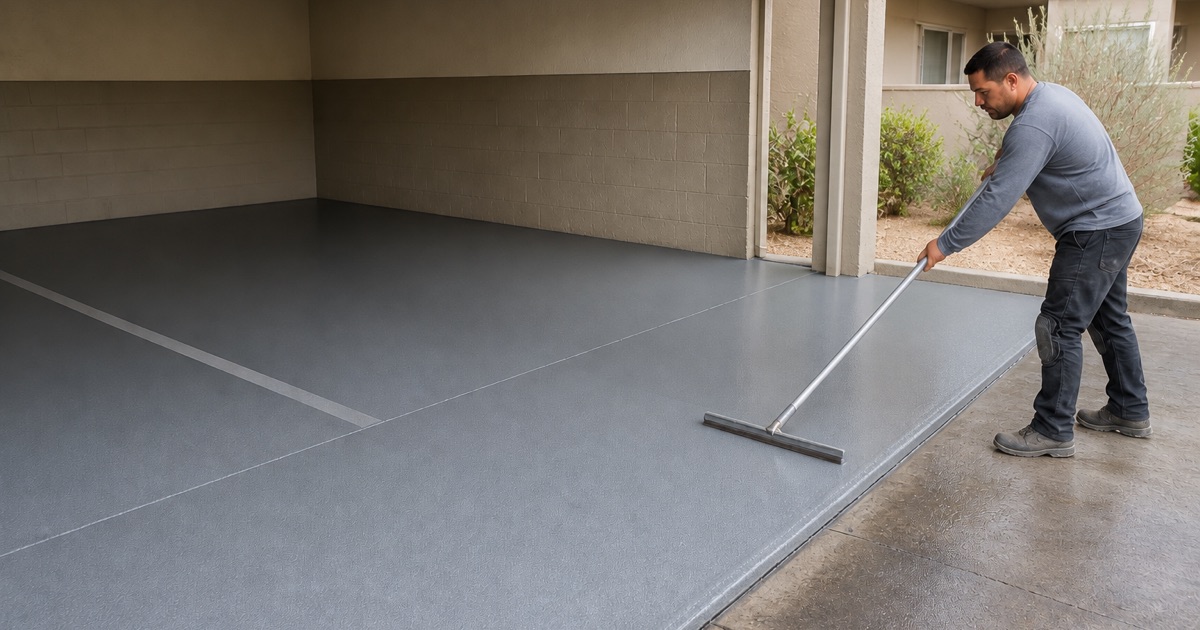
We schedule against slab temperature instead of the date on the calendar. That means early starts through the hot weeks, later starts in cool months, and a gauge rake, notched squeegee and air-release roller moving at the pace the material genuinely allows that morning.
- 20+ Years Experience
- Every Slab Moisture Tested
- Written System Spec