
Glendora Epoxy Flooring has been installing epoxy flooring in Baldwin Park for more than 20 years, and the logistics of getting to a job here are unlike anywhere else we work. Nothing about the approach is steep. Everything about it is busy, and those are two very different problems for a crew hauling a planetary grinder and a dust extraction rig.
So the first planning question on a Baldwin Park floor is what time of day a truck can actually reach the address and where it can sit once it does. That answer shapes the start time, the crew size and sometimes the day of the week. We settle it before a date goes on the calendar rather than discovering it at 7:00 a.m. on the morning of the grind.
Everything after that is the ordinary discipline of the trade: assess the slab, open the profile mechanically, specify a system in writing, and hold the recoat windows the product requires. What changes from address to address here is the access and the ownership, not the physics of the coating.
Access Here Is a Traffic Problem, Not a Grade Problem
The Southwest Corner and the Interchange
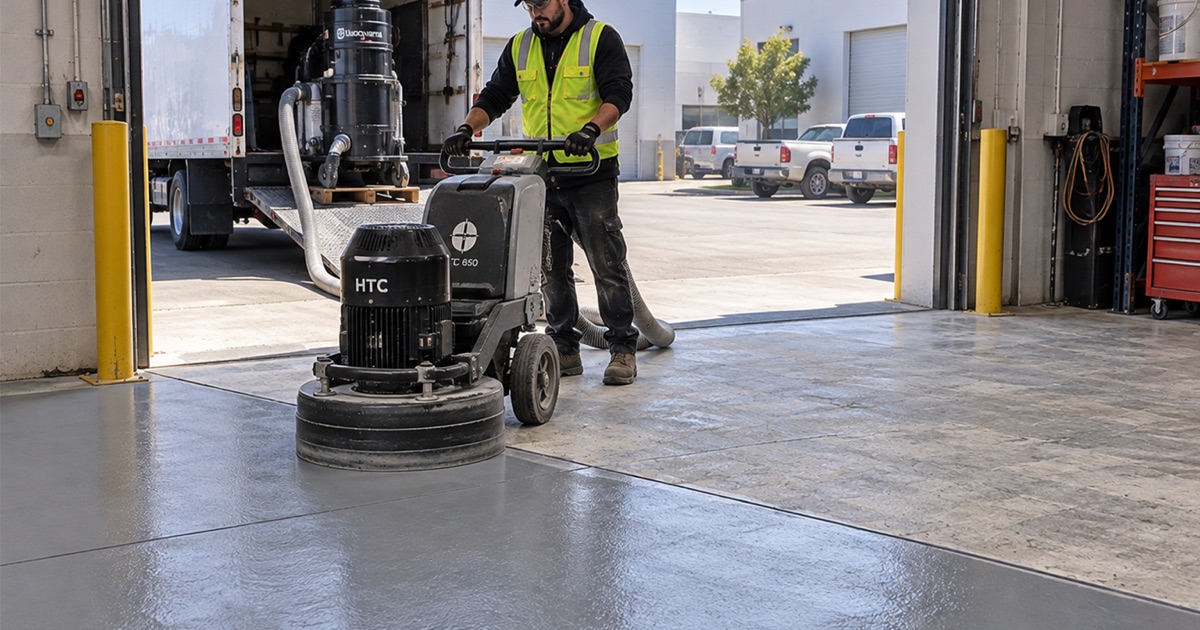
The I-10 and I-605 interchange sits in the southwest corner of the city, and the industrial buildings the trade actually works in cluster in that same quadrant along Garvey Avenue and Dalewood Street. Those are the addresses where a delivery truck, a container and our own rig are all competing for the same curb at the same hour.
We plan against that rather than around it. An early arrival before the freight day builds, or a start held until an afternoon lull, is often the difference between unloading in twenty minutes and losing an hour. It is a small piece of planning that protects the whole schedule behind it.
Nothing in This City Is a Hillside Job
Baldwin Park is valley floor. City Hall sits at roughly 375 feet of elevation, and every point sampled across the city — the civic center, the north edge and the southwest quadrant by the interchange — classifies as NonWildland in the Los Angeles County Fire Department’s Fire Hazard Severity Zones layer for local responsibility areas. There is no Very High Fire Hazard Severity Zone anywhere inside the city limits.
That matters because it removes a whole category of constraint that shapes work in the foothills. No steep approach to survey, no vehicle that cannot make the driveway, no equipment package chosen for slope. The flat ground gives us back the time that traffic takes away.
Staging the Truck, the Grinder and the Extraction Rig
On a residential street the staging question is simply where the truck sits and how far the hoses have to run. On the industrial side it is a negotiation with the building’s own operation, since a dock that is receiving freight is not a dock we can park across. We walk that with the facility contact before quoting a date.
Distance from the truck to the bay has a real cost, because material has a pot life and a long carry burns part of it. Keeping the rig close is not about convenience, it is about getting the resin onto the slab inside its working window.
Looking for epoxy flooring closer to South Monrovia Island? See South Monrovia Island Epoxy Flooring.
Narrow Original Bays on the Residential Side
Measuring the Bay Before Anything Is Quoted
The 1950s and 1960s account for 42.7% of the city’s housing stock, so the typical residential job here is an original garage rather than a modern one. A two-car bay from that era is materially tighter than a two-car bay built today, and the finished floor is smaller than most owners expect from the curb.
We measure it before quoting, every time. A square-footage figure guessed from a photograph is how a proposal ends up being renegotiated on the day of installation, and nobody enjoys that conversation. The number on our quote is the number we measured.
Running a Grinder in a Tight Garage
A narrow bay also limits the working room along the walls, which is where a grinder is least maneuverable and where the profile most often gets neglected. We plan the grit sequence and the edge work as separate operations rather than hoping the main machine reaches everything, stepping to PCD tooling where an old coating or sealer has to come off the perimeter first.
The target is a named ICRI concrete surface profile written on the specification, so there is an objective standard for what was delivered. Dust comes off at the tool through HEPA extraction, which in a tight garage with cars and stored belongings just outside the door is the only workable way to do it.
Joints, Spalled Edges and the Threshold
Every slab of this age has a story at the door, where the concrete meets weather, tires and whatever has been dragged across it. Spalled edges get rebuilt before the system goes down rather than being feathered over, because a coating cannot bridge a crumbling edge and will show the failure within a season.
Control joints and saw cuts get treated on their own terms too. Where movement has clearly stopped, a polyurea joint filler lets the coating run through cleanly; where it has not, the joint is honored rather than buried. That decision is made on the slab, not in the office.
Slabs Poured Before ASTM E1745 Existed
What the 1997 Specification Changed
ASTM E1745, the standard specification for plastic water vapor retarders used in contact with soil or granular fill under concrete slabs, was first published in 1997. Before that document existed, under-slab vapor protection was not a standardized part of residential construction, and what sits beneath an older pour varies from house to house.
That is a description of the industry’s history, not an accusation about anyone’s concrete. Plenty of older slabs perform fine. The point is that we cannot assume the barrier is there, which means the question has to be answered by measurement rather than by era.
Which Houses Here That Applies To
Baldwin Park has 18,669 housing units, 71.0% of them built before 1980 and 17.6% built in 1949 or earlier. That last figure is the one that matters for coating work, because it identifies a meaningful share of the city’s houses whose slabs went down decades before the modern specification was written.
On those addresses, testing the slab is an actual step in the job rather than a box ticked on a form. The result changes the primer and the price, and finding it out after material has been ordered helps nobody.
What We Do With an Elevated Reading
When the slab reads high, the answer is a moisture vapor barrier primer beneath the build, and a specification adjusted to suit it. When it reads comfortable, we go straight to the body coat and save the owner both a layer and a day. Either way the decision traces to a number rather than to an assumption about the neighborhood.
Whatever the result, it gets written down alongside the product, the mil build and the cure schedule. A quote that names all four is one that another bid can be compared against line by line.
When the Caller Is Not the Owner
Detached Houses With Tenants in Them
Baldwin Park is 42.3% renter-occupied while 68.4% of its housing units are one-unit detached homes. Put those two together and a substantial number of houses with private garages have a tenant living in them, so the person who wants the floor coated is frequently not the person who can authorize a permanent improvement to it.
We raise that early and without drama. It is a normal situation in this city, not an obstacle, and it only becomes a problem when it surfaces on installation day instead of during the quote.
Written Authorization and a Spec an Owner Can Approve
What we ask for is simple: written approval from the property owner or their manager before the work is scheduled. What we give the tenant to help get it is a specification that reads as a defined scope — named products, a stated film build, a cure schedule and a return-to-service time — rather than an open-ended request to redo a floor.
Owners approve defined scopes far more readily than vague ones, particularly absentee owners who will never see the garage. A one-page spec does more to move that decision along than any amount of persuasion.
Coating Category, Air Rules and the City Counter
Baldwin Park falls under the South Coast Air Quality Management District, and Rule 1113 caps floor coatings at 50 g/L VOC and industrial maintenance coatings at 100 g/L, with subsection (c)(6) prohibiting the application or solicitation of an industrial maintenance coating for residential use. A rental house garage gets a floor coating category product, and the industrial buildings by the interchange are quoted from the category that legally fits them.
Where a project involves the city, Building and Safety is an in-house division at 14403 E. Pacific Avenue, open Monday through Thursday from 8:00 a.m. to 5:00 p.m. and closed Friday. Fire protection is provided by the Los Angeles County Fire Department through the Consolidated Fire Protection District, with Station 29 on Los Angeles Street inside the city, and we name the right authority when a building’s requirements come up.
Scheduling Against the Slab and the Building’s Clock
Temperature drives the working window more than the calendar does. Pot life on the same product runs from roughly 60 minutes at 55 degrees down to about 20 minutes at 95 degrees, so a July garage gets smaller batches, an earlier start and a crew that keeps moving.
Occupied commercial buildings add their own clock. Kaiser Permanente Baldwin Park Medical Center is a 254-bed acute care hospital that never closes, and the In-N-Out distribution center on Hamburger Lane runs to a freight schedule, so floor work in facilities like those is phased rather than done in one shot. One crew stays with the job from the first grinding pass to the final topcoat, whichever clock it is running against.
- 20+ Years Experience
- Every Slab Moisture Tested
- Written System Spec