
Glendora Epoxy Flooring installs epoxy flooring in Azusa, and we have been building resinous floor systems across the San Gabriel Valley for more than 20 years. That span covers garage bays, podium decks, machine shops and production floors, and it has taught us that the coating itself is rarely the hard part. What decides whether a floor lasts is the slab underneath it and the air above it while it cures.
Our sequence is the same on every job regardless of size. We measure slab moisture with in-situ relative humidity probes to the ASTM F2170 method and write the reading down before a single pail is ordered, because moisture failure is the exclusion buried in nearly every coating warranty. We open the profile with a diamond grinder to a named ICRI concrete surface profile rather than acid etching, and one crew carries the floor from that first pass through the final topcoat.
What changes here is what the air is doing while that film is still open. Vulcan Materials runs the Azusa Rock quarry at the northwestern edge of the city, and the operation mines by blasting, moving granite aggregate out on a conveyor roughly two miles long to a plant in Irwindale. Airborne mineral dust is a live site condition on that side of town, and a wet floor left open to it does not stay clean.
Keeping grit out of a film that has not skinned over
Why an open coating collects what a cured one shrugs off
A finished resin floor is a sealed surface, and anything that lands on it afterward sweeps or mops away. In the hours between the pour and the moment the film skins over, that same surface behaves like flypaper. Mineral grit settles into the resin, sinks partway, and is locked there permanently once the material sets.
The consequence is not only cosmetic. Particles suspended at the surface interrupt the clear urethane topcoat, leave points where the film is thinner than the mil build called for, and hand abrasion somewhere to start. Taking them out later means grinding the coating off and beginning again, which is why we treat the air as part of the specification.
Containment built before the first grinding pass
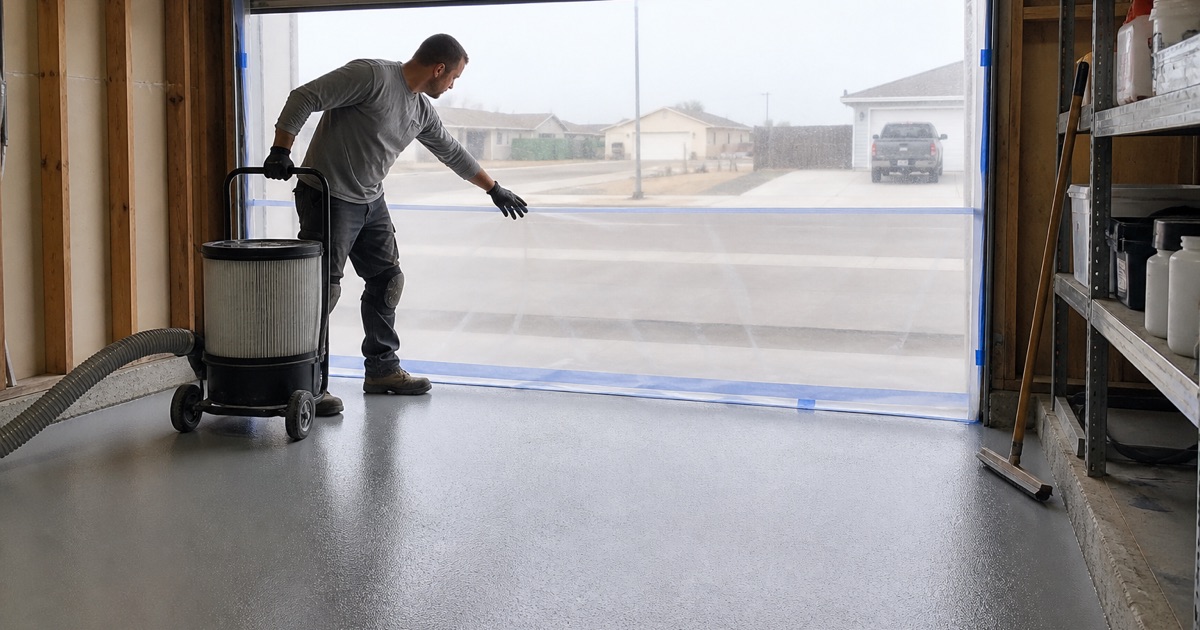
On the northwest side of the city we turn the bay into a sealed room before any tooling touches concrete. Door openings get a hard seal rather than a plastic drape, roll-up doors come down, and every gap that would let outside air move across the slab is closed first. None of that is possible to improvise once material is mixed.
The seal works in both directions, which is the part owners tend to appreciate afterward. It keeps blasting dust and haul-route grit off the wet floor, and it keeps our own concrete fines from drifting into the rest of the building, the yard and the parked cars while we grind.
HEPA extraction taken at the tool
We collect dust where it is made rather than chasing it around the room. The diamond grinder runs shrouded and tied into HEPA dust extraction, so concrete fines travel into the machine instead of into the air we have just gone to the trouble of sealing off. The grit sequence changes, the extraction does not.
That discipline counts for more here than it would on a sheltered street. When the outside air already carries mineral dust, a crew that generates its own cloud has no clean air left to fall back on, and the condition of the slab at the instant the primer coat goes down is what the whole system bonds to.
Looking for epoxy flooring closer to Covina? See Epoxy Flooring Services in Covina.
Scheduling around blasting and the haul-route rush
Working backward from when the primer has to go down
Aggregate operations put heavy trucks on the canyon-mouth routes, and that traffic runs heaviest in the morning. A grinder, a dust extraction rig, a generator and a material truck all have to reach the bay, and a crew that arrives late has already lost the coolest hours of the day. We plan for the traffic instead of being surprised by it.
So the schedule runs backward from the moment the primer coat has to be down, not forward from when the truck leaves our yard. On that side of town it usually means an early arrival, containment standing by mid-morning, and prep finished while the slab is still cool to the hand.
Slab temperature rather than the calendar
Pot life on a two-component system is governed by the temperature of the concrete, not by the date. The same product that gives roughly 60 minutes of working time on a slab at 55 degrees can fall to about 20 minutes at 95 degrees, and Azusa sits at the hot inland end of the valley. Booking a job on a calendar alone ignores the only variable that matters.
A west-facing garage or an uninsulated industrial bay runs above ambient right through the afternoon. We take a slab reading on arrival and size each batch to what the crew can genuinely spread with a gauge rake and notched squeegee before the material starts to thicken under the roller.
Holding the seal through the recoat window
Containment comes down when the recoat window closes, not when the crew packs up. A polyaspartic or polyurea topcoat reaches a dust-free state quickly, while a 100% solids epoxy build coat stays open considerably longer, and the system we specify therefore sets how long that room stays shut. Those are different jobs from a containment standpoint even on identical slabs.
We say this out loud at the quote stage because it decides how long the space is out of service. An owner who understands the cure schedule plans around it, while an owner who opens the door early to check on progress undoes the containment at the worst possible moment.
Floor systems for the workplaces here
Static-dissipative surfaces on aerospace and defense floors
Northrop Grumman employs roughly 859 people in Azusa, and floors inside that kind of facility answer to requirements a garage coating never encounters. ESD flooring with a static-dissipative topcoat, documented site access control and escorted-contractor procedures are the ordinary conditions of the work rather than exceptions to it.
We plan those projects around the escort, the badge and the shutdown window before we plan them around the resin. Safety striping and OSHA aisle marking are laid out on paper first as well, because a marked traffic lane is far cheaper to place before the topcoat than to add over it.
Cleanability and slip rating on food production floors
Food production is a real part of the employment base in this city, and those floors are washed down constantly. Urethane cement absorbs thermal shock and caustic wash chemistry far better than a straight epoxy, and a quartz broadcast set into the surface delivers the DCOF slip resistance a wet processing floor has to hold.
We detail the perimeter with cove base so the floor turns up the wall instead of meeting it at a seam that traps residue. Expansion joints and control joints get handled deliberately too, with a polyurea joint filler where the joint still has to move and a hard fill only where it does not.
Keeping the coating category legal for the building
Azusa falls under the South Coast Air Quality Management District, where Rule 1113 caps floor coatings at 50 g/L VOC and allows industrial maintenance coatings up to 100 g/L. Subsection (c)(6) bars industrial maintenance coatings from residential use outright, which is a line worth knowing before a product is ordered.
With a genuine industrial base and a large multifamily base inside the same 9.67 square miles, keeping those two categories on the correct side of that line is daily discipline rather than paperwork. We choose the category against the rule and name the product, the mil build and the cure schedule on the quote, so two bids can actually be set side by side.
Newer slabs, shared decks and buildings that close on a schedule
Young concrete around the Metro stations
About 9.1% of the housing stock here went up between 2010 and 2019, concentrated around the Downtown Azusa and APU/Citrus College stations on the Metro A Line. That is newer concrete than we see almost anywhere in the valley, and generally better-placed concrete as well.
Newer does not mean drier. A slab that young can still be releasing residual construction moisture, and the moisture vapor emission rate on a green slab has no relationship to how good it looks. This is exactly why the relative humidity probes go in before material is ordered rather than after a coating has already blistered.
Podium decks and shared parking structures
Detached single-family homes account for only 47.6% of Azusa’s housing units, with 14.9% attached and 17.5% sitting in structures of five units or more. A great deal of the housing here comes with no private garage at all, so a residential inquiry is often about a podium deck, a tuck-under bay or a shared parking structure instead.
Those floors are decided by an HOA board or a property manager rather than by one owner, which changes how the finish gets chosen. We lay a vinyl flake broadcast or a metallic pigment sample directly on the slab in question and let the group look at it under the light that building actually has, because a chip in a binder under showroom lighting settles nothing.
Buildings that can only be taken offline in a window
Azusa Pacific University sits inside the city on Foothill Boulevard and is the single largest employer here. Shop, lab, kitchen and corridor floors on a campus of that size get scheduled between terms, because there is no version of this work that coexists with a room still in use.
The same logic governs a production line or a school district building. We size the scope to the shutdown that is genuinely available and write the cure schedule into the quote, so the date the floor can carry traffic again is a number on paper rather than a guess made over the phone.
Permitting, where a project calls for it, runs through the City of Azusa Building Division within the Economic and Community Development Department on East Foothill Boulevard. We would rather confirm that in advance than discover it midway through a shutdown window that cannot be extended.
- 20+ Years Experience
- Every Slab Moisture Tested
- Written System Spec