
Glendora Epoxy Flooring installs epoxy flooring in Arcadia, and after more than 20 years on San Gabriel Valley concrete we treat this city as two markets sharing the same streets. A single block here can hold an original mid-century garage and a recently rebuilt house with a far larger bay. The floor under each is a different job.
So the first thing we establish is which of the two we are looking at. We measure the bay, test the slab and identify the approvals that apply before a number is written down. Every quote then carries a system spec naming the product, the mil build and the cure schedule, so the specification is legible rather than implied.
Preparation is mechanical throughout. A diamond grinder opens the profile to a named ICRI concrete surface profile, HEPA extraction collects dust at the tool, and acid etching plays no part in it at all. One crew stays with the floor from that first pass through to the clear urethane topcoat.
Two approvals, not one, in the association neighborhoods
Five associations recognized by City Council resolution
Arcadia Highlands, Rancho Santa Anita Property Owners, Santa Anita Oaks, Rancho Santa Anita Residents and Santa Anita Village are each recognized by City Council resolution, and each runs an Architectural Review Board with architectural design review authority over its association area. The City publishes short-review and regular-review ARB application forms and routes applicants to the HOA president or the ARB chair. That is a genuine second layer of approval above the city counter.
It also sits in exactly the neighborhoods where most of the rebuilding is concentrated, which is why we ask about it on the first call. Knowing whether a property falls inside one of those areas changes the timeline before it changes anything else. Asking is far easier than unwinding.
What a review board looks at, and what it does not
Architectural review is design review, and its attention is on what the street and the neighbors can see. A garage floor inside a closed bay is not usually the subject of that scrutiny, and we say so rather than manufacturing a process where none exists. The real question is whether anything else in the project touches the exterior.
A new door, a widened apron, an exterior light or a change to the driveway can all pull the work into review. We identify that at the walkthrough so nobody discovers it after materials have been ordered. Where a submission is genuinely needed, the schedule accounts for it instead of assuming around it.
The city counter on West Huntington Drive
Building Services sits within the Development Services Department at Arcadia City Hall, 240 West Huntington Drive, and implements and enforces city and state codes for construction, remodeling, alteration, repair and demolition. The counter runs Monday through Thursday 7:30 a.m. to 5:30 p.m. and Friday 7:30 a.m. to 4:30 p.m., closed on alternate Fridays, with plans accepted up to a half hour before closing.
Coating an existing slab is not usually what pulls a permit. The trigger is normally the adjacent work an owner attaches to it, such as a new circuit, added lighting or a mechanical change. We flag those early so the calendar reflects a plan check and an inspection whenever one is coming.
Looking for epoxy flooring closer to Sierra Madre? See Sierra Madre Epoxy Flooring.
A city rebuilding itself one lot at a time
Old stock and new stock inside the same figures
Of Arcadia’s 20,992 housing units, 69.0% predate 1980 and the 1950s alone account for 26.4%, some 5,541 units. Yet 16.1% of the stock was built in 2000 or later, which is a striking share for a city that old. Those two numbers describe a single process: houses coming down and larger ones going up on the same lots.
For a floor contractor that means the address tells you almost nothing on its own. A 1955 ranch with an original narrow two-car bay can sit next door to a replacement house with a wide three-car garage on young concrete. Prep scope, moisture risk and finished dimensions all differ, so we look before we quote.
A demolition certificate and a historian’s assessment
Arcadia requires a separate Certificate of Demolition, decided by the Director and appealable to the Planning Commission and then the City Council, at a fee of $1,260 plus CEQA fees where it is referred to the Commission. That is a distinct approval from the building permit itself. Owners planning a rebuild rather than a remodel run into it early.
The General Plan’s Implementation Plan program 11-4 goes further, requiring a qualified architectural historian to assess the significance of any structure 50 years of age or older before a demolition permit is issued. In a city where 69.0% of the stock predates 1980, that captures most of the housing. It is one reason rebuild timelines here run longer than owners expect.
What the size ordinance changed about the bay
The mansionization ordinance the City Council adopted effective May 20, 2016 caps single-family house size by floor area ratio and sets minimum side yards of 10 feet or 10% of lot width, with rear yards of at least 25 feet and separate rules for hillside homes. Projects with design review approved before that date were grandfathered. Garage footprints on newer builds reflect those constraints.
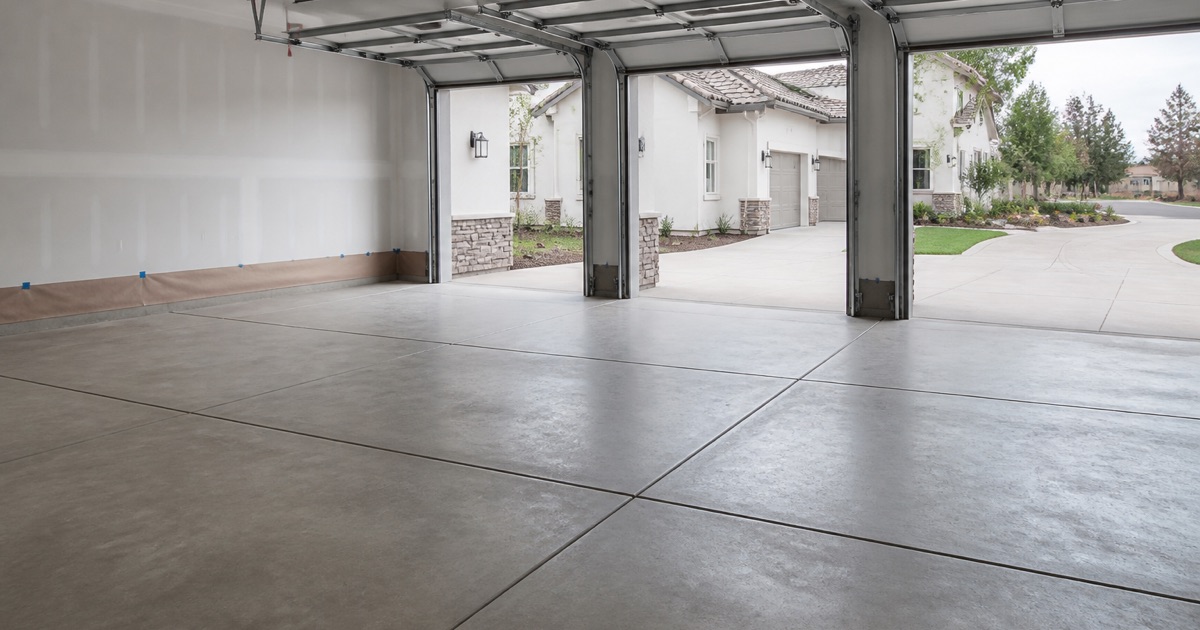
The practical result is a housing stock in which garage width is genuinely unpredictable from the curb. We measure the bay at the estimate and quote a finished area from that measurement rather than from a nominal two-car or three-car figure. The same measurement fixes the material order, which is not a number worth approximating.
Two slab ages, two different tests
Young concrete and the moisture that has not left yet
A slab poured recently still carries mix water that has not finished leaving, and coating over it is a straightforward way to seal the problem in under a film. Age is not the same thing as dryness on a new pour. We treat recently built garages as a moisture question in their own right rather than assuming that modern means safe.
So we measure with in-situ relative humidity probes to the ASTM F2170 method and record the result before any material is ordered. Moisture failure is the exclusion carried by nearly every coating warranty, which makes a documented reading worth considerably more than an opinion. A high number moves the build toward a moisture vapor barrier primer rather than stopping the project.
Older slabs and the tests that belong in scope
Around 3,128 units here predate 1950, and slabs of that era were commonly placed with nothing beneath them. On that stock, ASTM F2170 relative humidity testing or ASTM F1869 calcium chloride testing belongs in the scope from the outset rather than appearing later as an addition. The threshold values themselves live in ASTM F710, not in the test methods.
ASTM D4263, the plastic sheet method, is worth understanding chiefly for what it cannot do. It is indicative only, and it is asymmetric: a positive result fails a slab, while a negative one proves nothing whatever. We never let it stand in for a quantitative reading on concrete this old, because the consequence of being wrong lands on the finished floor.
Measuring an old bay against a new one
A mid-century two-car garage is materially narrower than a modern one, and the working room for a planetary grinder inside it is tighter as well. That affects the schedule as much as the square footage, because a confined bay slows every pass. We account for the room we have to work in, not only the area we will coat.
Color gets decided on the actual slab as well. We lay flake blends and metallic pigment samples on the customer’s own concrete instead of showing a chip in a binder under showroom lighting, because the gray beneath and the light in the bay both change how a blend reads. A new slab and a seventy-year-old one look different under the same product.
Foothill lots, shared parking and the heat
Lots at 20% average slope
Arcadia’s hillside development standards apply to the R-M zone and to any lot with an average slope of 20% or greater, a threshold written into the zoning code rather than an impression formed from the street. On grades like that, getting a box truck, a planetary grinder and a dust extraction rig to the bay becomes a survey question. We answer it before a date is promised.
Along the northern foothill edge the City designates Very High Fire Hazard Severity Zone area and publishes an address-searchable map through its Fire Prevention Bureau. Garages in that band are frequently packed with equipment and stored goods. All of it has to come out before the slab is even visible, which makes clearing the bay a scheduling conversation rather than a footnote.
Parking structures, stairwells and where Rule 1113 lands
Rentals account for 41.9% of occupied units in Arcadia, and a substantial share of the stock sits in buildings of two or more units, which is a different mix from the detached-heavy communities nearby. That produces floor work on a turnover schedule: parking decks, stairwells, laundry rooms and trash enclosures rather than a single family bay. Specification and sequencing both change with it.
It is also where the coating category has to be right. Rule 1113 from the South Coast Air Quality Management District caps floor coatings at 50 g/L VOC and industrial maintenance coatings at 100 g/L, and subsection (c)(6) prohibits applying or soliciting an industrial maintenance coating for residential use. An apartment building’s parking structure is residential property, however industrial the wear on it looks.
Cure on an inland slab
Slab temperature governs the working day here. On one published product, pot life runs roughly 60 minutes at 55 degrees, about 40 minutes at 72 degrees and around 20 minutes at 95 degrees, while the recoat minimum collapses from 24 hours to 6 hours across that same range. Early starts and small batches are the answer, not more hands.
Two further limits sit alongside it: a floor of 5 degrees above dew point, and a maximum surface temperature of 160 degrees that an uninsulated inland slab can genuinely approach in summer. We take readings on the concrete rather than trusting the air temperature. The cure schedule is printed on the quote so nobody has to guess when the bay comes back into use.
- 20+ Years Experience
- Every Slab Moisture Tested
- Written System Spec